
By Dennis Abrams and Edward Nawotka
There are, essentially, just two different kinds of cookbooks. The first is what can indelicately be called “food p*rnography.” It depicts food that one wants to make but knows is virtually impossible to replicate in a home kitchen, food that exists only in restaurants and one’s fantasies. The second kind of cookbook is the one you want to get down and dirty with—the practical cookbook. You know you’re going to cook everything in it, and you know that by the time you’re done, the pages are going be covered with the stains of your efforts.
This year, in honor of the US holiday of Thanksgiving—that most decadent feast day of indulgence—we offer an example of each genre in the form of two of the hottest cookbooks published this season:
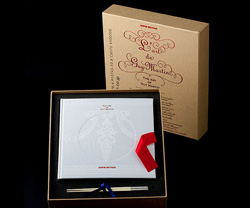
L’art de Guy Martin falls firmly in the food p*rn category. The massive 636-page tome contains a mere 63 recipes from Martin, the manager and chef de cuisine of Le Grand Véfour, the famous Parisian restaurant founded in 1760. It features a veritable buffet of luscious photography—203 images of plated dishes and another 154 of sundry ingredients. Often a shot features just a simple image of one perfectly formed morsel with a few words of encouragement. The opening spread, for example, depicts a plate of fine china with the words “Bon Appétit” overlaid on top. What follows is a complicated arrangement of pages, featuring virtual food “pop-ups” and transparencies that convey the various “layers” of a dish. It is even bound in a genuine linen tablecloth from Le Grand Véfour.
The book, published by SuperEdition of Tokyo, Japan, is intended to be purchased and treated as work of art: it is limited to an edition of 3,000 copies and priced at a not insignificant ¥52,500 ($600). For that price the book includes an unexpected touch, particularly for a French cookbook: a pair of silver-tipped Christofle chopsticks. (Watch a brief interview below with Olivier Desobeaux from SuperEdition discussing L’art de Guy Martin.)
httpv://www.youtube.com/watch?v=4QWm32OT02c
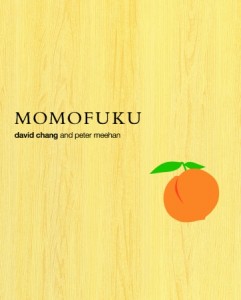
Momofuku by David Chang and Peter Meehan, is decidedly more modest—the price is a mere $40 and the cover is adorned with a simple illustration of a peach on a wooden chopping block. And though the book covers what Chang calls “bad-pseudo fusion cuisine,” it does not come with its own chopsticks. What it does come with is that is perhaps unique among cookbooks is vulgarity: Chang, to put it mildly, likes to punctuate his speech with a not-too-infrequent f-bomb.
Surprisingly, Momofuku falls into the second category of cookbooks—those that beg to be put to use. It is surprising because Chang is the chef/owner of three restaurants. Momofuku Noodle Bar, Momofuku Ko, and Momofuku Ssam Bar, all in New York City, which have received virtually every restaurant award the industry has to offer, and restaurant quality Asian food, even of the “bad-pseudo fusion cuisine” type, is often seen as being outside the reach of even the most talented home cook. At least until now.
 Looking through Chang’s book, folding over page after page, makes you want to say “I’ve got to make that.” Some dishes, such as Ginger Scallion Noodles and Marinated Hanger Steak Ssam with Red Kimchi Puree are sure to become everyday favorites. Other dishes, such as Spicy Pork Sausage & Rice Cakes with Chinese Broccoli and Crispy Shallots, and Chang’s legendary take on Fried Chicken are perfect Sunday dinners. And then there are the dishes that are truly ambitious (but still manageable) and perfect to impress guests with: Bo Ssam (a Korean slow-cooked pork shoulder accompanied with a variety of sauces and oysters!) and Momofuku Ramen are high on that list of such dishes.
Now, not everything in the book is eminently doable—making your own alkaline noodles (aka ramen)? No thank you. Still, it’s a fair prediction that within just a couple of months, Momofuku is going to be showing signs of use on nearly every page, while L’art de Guy Martin looks on from a high perch up on the shelf or the coffee table, for which it was obviously designed.
Cookbooks are currently something of a bright spot in book sales, which declined overall by about 5% in 2008, while the cookbook category declined by only between 1% and 2%, according to Simba Information, a media research company in Stamford, Conn. Publishers in the USA released 3,277 cookbooks last year, up from 2,836 the year before, according to R.R. Bowker, a publishing research firm.
VIEW: An online gallery of L’art de Guy Martin on the SuperEdition web site.
BUY: A copy of the Momofuku cookbook
READ: An interview with David Chang