


By Carlo Carrenho, Contributing Editor
Among the week’s headlines: German speaker box company Tonies posts strong first half growth; a Japanese publishers celebrates its 100th anniversary with free manga; why Bookwire’s partnership with Dutch distributor CB is a big deal; Germany’s Ravensburger and Polish publisher AMEET strike a distribution deal; and self-published titles make up more than half of Russia’s ebook market.Tonies Shows No Signs of Toning Down
 Children’s audio company Tonies reported first-half 2026 revenue of € 242.9 million (USD 283.7 million), up 38% year over year, or 41% on a constant-currency basis, according to its August 20 earnings release. North America, now its largest market, was also its fastest growing, with revenue rising 48% to €104.3 million ($121.8 million), while DACH sales increased 26% and the rest of the world 41%. Strong demand for the Toniebox 2 helped drive growth, and Tonies said markets outside DACH now account for 63% of group revenue. The company reaffirmed its full year forecast of more than €760 million ($887.8 million) in revenue, and an adjusted EBITDA margin of 9 to 11%.
The continued growth of Tonies beyond its original, more mature DACH market is remarkable and shows how important speaker boxes are becoming for children’s audiobooks—and potentially for building an audience as those children grow. Tonies is not alone: UK-based Yoto also operates internationally; there’s Faba in Italy; Galakto in Germany, and a few others. At the same time, Tonies is still far from being present in every market, with its business so far concentrated largely in DACH, English-language markets, and France. That leaves an interesting question: Where will Tonies take its international expansion next?
DoShueisha Gives Manga Pirates Their Own Medicine
 Shueisha announced the launch of MANGA MILLION, a free global digital manga service marking the Japanese publisher’s 100th anniversary. Available through December 2027, the service will offer 1 million pages from about 400 manga titles translated by professional translators into more than 100 languages, with only limited content available in Japan. Around 300 titles are receiving English translations for the first time, while works including One Piece, Naruto, Bleach, Demon Slayer, Jujutsu Kaisen, Nana, and Spy × Family are among those included. Shueisha also plans near-simultaneous publication of the latest chapters of about 30 current series, generally two to three weeks after their Japanese release.
The move is particularly interesting in two ways. First, as Japan’s manga industry grapples with widespread concern over digital piracy abroad, making such a large volume of content temporarily available for free could offer another way to compete with unauthorized distribution. Second, it reflects a broader shift among Japanese publishers toward publishing their content directly in other languages rather than relying exclusively on licensing rights to overseas publishers. MANGA MILLION could also give Shueisha substantial data on readership and consumption patterns across global markets.
Bookwire Goes Dutch—and Goes Big
 According to Publishing Perspectives, Bookwire and Dutch book distributor CB (Centraal Boekhuis) have announced a long-term strategic partnership for digital distribution in the Netherlands. Bookwire has onboarded CB’s digital catalog of some 80,000 ebooks and 25,000 audiobooks and taken over digital fulfillment for its network, while publishers will continue to work through CB’s existing interface. The collaboration serves more than 500 publishing partners and distributes content to more than 200 channels, including Kobo, the Dutch Royal Library, and more than 130 local webshops. CB says the move will allow it to phase out legacy technology while adopting Bookwire’s distribution platform.
This may look like routine digital-distribution news, but CB’s position as the Netherlands’ main book distributor makes the partnership a significant entry into the Dutch market for Bookwire, putting it in a strong, potentially dominant position in digital book distribution there. It is also notable that CB, traditionally a print book distributor, sees the partnership as a way to phase out legacy technology. With Bookwire backed by VC capital from Insight Partners, its technology can be expected to continue developing. Let’s not forget that the Netherlands is an important market for ebooks and audiobooks, with strong digital distribution through libraries, and is one of Storytel’s core markets.
AI and BI for the Publishing Eye—Made in Brazil
 Brazil’s PublishNews reports the launch of Publitik, a subscription-based market-intelligence platform that tracks global book-industry news, research, bestseller lists, social-media trends, and other indicators in real time. Using AI agents, Publitik gathers information from specialist and general media in dozens of countries, while allowing publishing professionals to monitor topics, markets, authors, and books and customize alerts. The platform currently has about 100 subscribers, and a mobile app is scheduled to launch before the end of the year.
This is an interesting application of AI for the publishing industry: Publitik is essentially a global business-intelligence tool, using AI to give book professionals fast, in-depth analysis based on information from markets around the world. Already available in English as well as Portuguese, the platform also attempts to bring together bestseller lists from multiple countries, aiming to provide a broader view of what is selling in individual markets and which titles are emerging as global bestsellers.
Polish LEGOs, in Print, Cross the German Border
 According to Börsenblatt, Germany’s Ravensburger will begin distributing a selection of LEGO books from Polish children’s publisher AMEET in Germany, Austria, and Switzerland with its spring 2027 program. Around 40 new releases and 60 backlist titles are expected to be distributed through Ravensburger through the partnership, including activity books based on LEGO NINJAGO, LEGO Star Wars, and LEGO Minecraft. AMEET, which entered the German-language market in 2015, says the agreement will expand its reach across book and toy retail channels in the DACH region.
The Polish publishing market tends to be underestimated, and the AMEET-Ravensburger deal is another example of the dynamism and entrepreneurship coming from Poland. The partnership also points to an interesting model: a publisher producing foreign-language content for distribution directly in another market—in this case, German-language books developed in Poland for German-speaking readers. As translation becomes increasingly accessible and publishing becomes more global, we may see more companies producing books, in print as well as digital formats, in languages other than their own.
Spiracle Raises Its Volume in the UK
 The Bookseller reports that U.K.-based Spiracle Audiobooks will launch a new platform and app, “Spiracle 2.0,” expanding its catalogue from around 2,000 audiobooks to more than 70,000, including titles from major publishers as well as independents. Founded in 2022 to champion small and independent presses, Spiracle says the expanded service will emphasize human curation, community recommendations and customer ownership of purchased audiobooks. Membership will start at £8.95 ($12.20) per month, including one audiobook credit monthly, while new publisher relationships include Penguin Random House and Bloomsbury. Spiracle also plans to deepen its work with U.K. bookshops through audiobook clubs and an expansion of its “Audiobook in a Card” retail program.
A stronger audiobook market needs retailers beyond the big global platforms, so the launch of Spiracle 2.0 is more than welcome. Its expansion also underscores how critical catalogue breadth is for smaller retailers seeking to grow and compete: Spiracle has moved beyond its original focus on independent publishers to add titles from the major houses. Consumers want choice and a comprehensive catalogue, and without it they are likely to gravitate toward the largest platforms. In this context, it is important to emphasize that maintaining a competitive market requires publishers—and particularly aggregators and distributors—to make their catalogues available to smaller platforms as well as the dominant players.
Carlsen to OpenAI: NEIN Means Nein
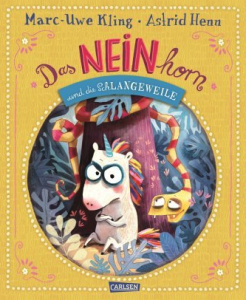 Börsenblatt reports that German children’s publisher Carlsen has filed suit against OpenAI, together with author Marc-Uwe Kling and illustrator Astrid Henn, alleging infringement of rights associated with their bestselling children’s book Das NEINhorn. The Hamburg-based publisher has the support of its parent company, Bonnier, in the action. Carlsen says ChatGPT can generate stories and illustrations closely resembling the original work, as well as print-ready material incorporating its characters, a fabricated ISBN, and the publisher’s logo. Carlsen alleges that the outputs indicate the original NEINhorn works were used without authorization to train OpenAI’s language and image models.
It’s another sign that legal challenges to AI companies such as OpenAI and Anthropic are not confined to publishers and authors in the U.S. English-language market. Similar cases are now emerging in Germany, and with Carlsen Germany part of the Swedish Bonnier group, this could become an interesting fight to follow in the courts.
The Books Amazon Buys—and Doesn’t Sell
 Ars Technica reports that Amazon is buying rare and older books through commercial channels and sending them to a Las Vegas facility where workers remove the books’ spines and scan their pages, effectively destroying them. The report cites an investigation by 404 Media, which tracked an AirTag hidden in a rare book sold as part of a bulk order to the facility. Amazon declined to comment specifically on whether the books are being used for AI training, saying only that it “purchases books through commercial channels to help develop and improve the products and services our customers use.”
This appears to add Amazon to the growing list of companies reported to be acquiring books for AI training, an issue that has already caught the attention of the book business (including a recent communication from Ingram, as reported by Publishers Weekly). Along with the legal questions around how copyrighted content can be used for AI training, Amazon’s involvement adds another dimension.
Russian Indie Authors Occupy Digital Territory
 Russia’s self-publishing market reached more than ₽2.7 billion ($31.7 million) in the first quarter of 2026, up 13% year over year, according to LitRes data and reported by TASS. Self-published titles now account for 61% of Russia’s ebook market, while half of LitRes’ top 20 bestselling authors are digital-first writers. Fantasy, science fiction, contemporary romance, and crime remain the leading self-publishing genres; Litnet also reported sharp first-half growth in niches including paranormal romance, dark fantasy, and action fantasy.
Russia’s book market, despite the country’s relative isolation due to its war on Ukraine, continues to show similarities with markets elsewhere, including the strong presence of self-publishing, particularly in digital formats. LitRes, Russia’s largest digital book platform controlled by the Eksmo group, reports figures that emphasize the sector’s importance. One notable distinction is the enduring popularity of science fiction, traditionally one of Russia’s leading genres. Also significant is that, despite increasing censorship and regulation of the Russian book market, self-published authors continue to publish.
What Else Caught My Eye
A puppet book. GZERO Media created a wonderfully ironic puppet video entitled “World Leader Book Club,” showing what Putin, Trump, Lula, Merz and other political leaders might keep on their nightstands. Watch it here.
A Viking appetite. Danish publisher Saga Egmont has acquired Berlin-based children’s publisher Kindermann Verlag, its third German acquisition after dotbooks and Gmeiner. According to Börsenblatt.
A happy tango. Argentina’s government has dropped plans to abolish the country’s fixed book price law following strong opposition from booksellers and publishers. According to PublishNews Spain.
A bookshop pint. More than 200 U.K. independent bookshops are urging the government to give them the same business rates relief recently granted to pubs, clubs, and live music venues. According to The Bookseller.
A sauna murder. Book sales in Finland grew over 4% year on year during the April-June period, with printed books on the rise and crime fiction leading summer sales. According to Yle.
A manga domain. Kodansha is applying for the “.manga” top-level internet domain in an effort to combat the proliferation of manga piracy websites. According to Bunka News.
A biblical alliance. Germany’s Protestant and Catholic Bible societies are joining forces for the first time to celebrate the anniversaries of their respective modern translations. The ecumenical campaign includes special editions and joint promotion in bookstores. According to Börsenblatt.
The writer of this column returns refreshed after a month in his Sardinian paradise, Santu Lussurgiu, and claims to be ready for another year in this space. On his traditional drive home to Sweden, he stopped in Nördlingen, his favorite romantic German town: a medieval jewel completely encircled by its city wall and sitting inside a crater formed by an asteroid impact some 15 million years ago. Its historic buildings contain millions of microscopic diamonds created by the impact, and Nördlingen was also the hometown of the legendary footballer Gerd Müller, the “Bomber of the Nation”—which is almost reason enough to visit. The real reason, however, lies 15 kilometres away in Oettingen: Boteco La Dhany and its authentic cuisine from Bahia. Geology is fascinating, football history is great, but they cannot compete with Brazilian food.