
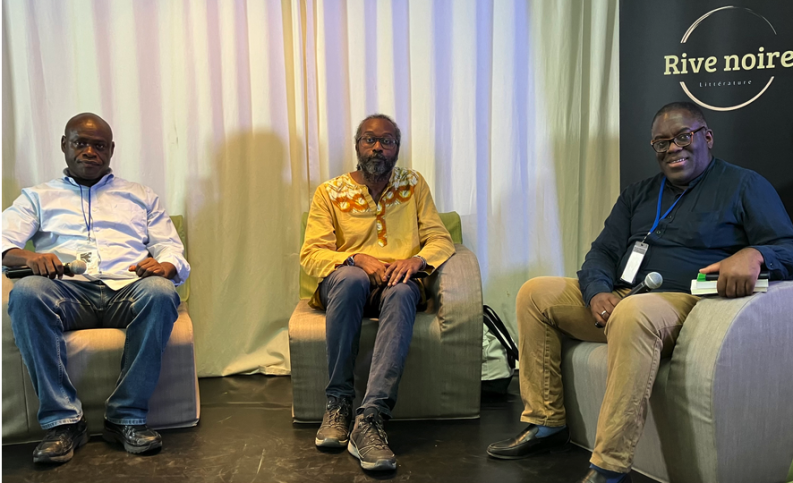

From left: Philomé Robert, Amzat Boukari-Yabara, and Rive Noir festival organizer Réassi Ouabonzi (credit: Olivia Snaije).
By Olivia Snaije, Contributing Editor
As a record breaking 9-day heat wave came to an end in Paris, two very different literary festivals that focus on the African continent were held in the capital. One, Maghreb des Livres, well-established but trying to rebuild momentum after several years of decline, and Rive Noir; small, young and dynamic, operating on a shoe-string and on the upswing.For Rive Noir’s second edition, it partnered with Afrolivresque, a website on African literature. Literary events and author interviews were held throughout one day, with authors from sub-Saharan Africa, the Caribbean, and the U.S.
Rive Noir’s official ambassador this year was the Senegalese author Mohamed Mbougar Sarr, who won France’s prestigious Prix Goncourt in 2021 for his fourth novel, La plus secrète mémoire des hommes (The Most Secret Memory of Men).
Approximately 150 people were in attendance, with hundreds more watching the livestreamed events in Goma, Democratic Republic of Congo (DRC) and in Porto-Novo, Benin. Three platforms, a literary agency, Fil Goma, and Elmagazine, in the DRC, and Fémicriture in Benin relayed the livestreaming.
‘A Real Conversation Between These Shores’
Rive Noir is organized by Réassi Ouabonzi, well-known for his interviews with African and Afro-descendent authors on his web series, Les lectures de Gangoueus.
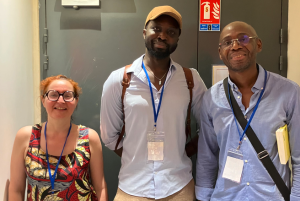
From left: Annie Ferret, Mohamed Mbougar Sarr, Joss Doszen (credit Olivia Snaije).
Many of Rive Noir’s authors have been guests on Ouabonzi’s show, such as Mbougar Sarr, who said that Ouabonzi has followed him since his first novel. Mbougar Sarr praised the high quality of Rive Noir’s programming, underlining that it always includes debut and young authors. “He [Ouabonzi] uses his knowledge of literature and different geographical regions to put together a real conversation between these shores.”
The panels included subjects such as the links between Haiti and the African continent, writing about an immigrant parent’s journey, or writing from France as a Black American. There was a space where books by the authors could be bought provided by the Africa Vivre platform.
Philomé Robert with his book, Port-au-Prince Cotonou: un écho sans retour (an unanswered echo) and Amzat Boukari-Yabara with his Africa Unite! discussed the return of Afro-descendents to the Continent, and in particular Haitians. Boukari-Yabara reminded the audience, against the backdrop of the grave humanitarian crisis Haiti is in today, that the country was once an inspiration for the Black world, exemplifying Black resilience and freedom.
Eve Guerra and Romuald Gadegbeku, part of a new generation of authors, talked about their immigrant parents with the writer Joss Doszen. Guerra, born and raised in Congo-Brazzaville, and today a professor of Latin, Ancient Greek and French in Lyon, won the Prix Goncourt for debut novels with her Rapatriement (Repatriation) which explores the death of her father.
Journalist and writer Gadegbeku, born in France of Togolese parents, wrote about hotel housekeepers on strike in Les Gréveuses (the strikers), loosely inspired by his mother’s experience as a housekeeper.
Zimbabwean author Lucy Mushita who was a Rive Noir guest in 2025, commented that the day-long event “is a space where no one is thinking about whether you’re Black. People are judged by the quality of their writing and not the color of it.” She added that panel moderators “know what they are talking about because they have the cultural references, which is very important.”
This was the first time that Ouabonzi had experimented with livestreaming in order to “go a little beyond the Seine,” he told Publishing Perspectives. “We want to create demand. We’ll have to examine the statistics to see if it’s worth it because it’s an expensive endeavor.”
For the next edition Ouabonzi said he wants to professionalize the event, building on his concept of creating a festival that focuses, besides the literary aspect, on communication and discovery. “We want young journalists and influencers to be able to meet writers,” he said, “a space where we can curate and create possibilities for new generations.”
Rejuvenation
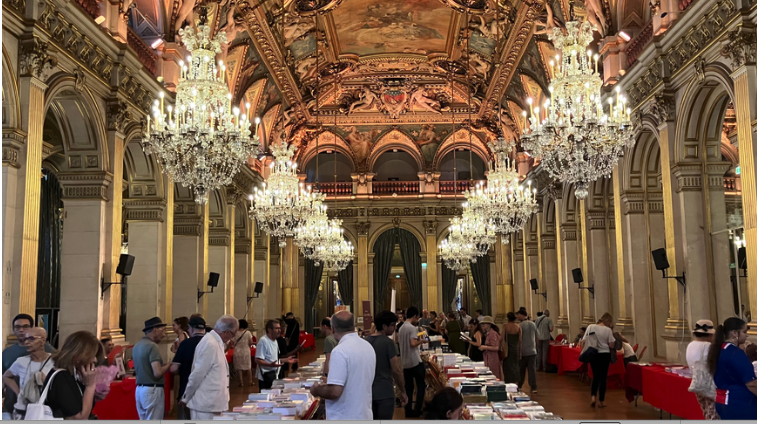
Maghreb des Livres in Paris’ Hotel de Ville (credit: Olivia Snaije).
The 32nd edition of Maghreb des Livres was held June 27 and 28 in Paris’s impressive 19th century Hotel de Ville (city hall), which has hosted the event since 2001. With funding from, among others, the region Île de France and the Centre National du Livre (CNL), Maghreb des Livres is run by an organization, Coup de Soleil, founded in 1985 to promote culture and literature from the Maghreb region (North Africa) and to counter racism.
Although Maghreb des Livres had a brief partnership with the French think tank iReMMo, expanding its focus on North Africa to include the Middle East, the past four editions have returned to spotlighting its original focus on three countries, Morocco, Algeria, and Tunisia, with Tunisia as this year’s guest of honor.
The main room in the Hotel de Ville is where books in French or translated into French are sold and author signings are held, while round tables and author interviews are held in adjacent rooms. Round tables took place on subjects such as democracy in Tunisia, Tunisian comics, or the legacy of colonialism. Homages were held for the late Algerian anticolonial militant and historian, Mohammed Harbi and the Palestinian diplomat Leila Shahid, who both died this year.
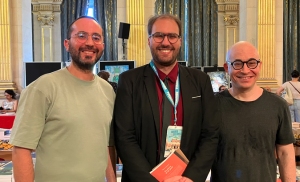
From left: Fares Lounis, Anis Kellou, Adam Shatz (credit: Olivia Snaije).
The organizers are open about the festival’s declining numbers and attribute it to a lack of communication and the need for broadening the event’s appeal.
Anis Kellou, who formerly worked in the cultural division of the French Embassy in Algeria was hired in 2024 to manage the organization, taking over the project management from Coup de Soleil’s founder and president, Georges Morin, now in his 80s.
Although Morin remains involved in Maghreb des Livres, Kellou has taken charge of running the festival, and told Publishing Perspectives that while the mission of the festival remains the same, he is trying to improve communication—an Instagram page was created a month ago—and would also like to reach out to communities around Paris that might be interested in the event. He added that two Mauritanian authors, Beyrouk and Sidi Ahmed Cheine, and Malian author and filmmaker based in Mauritania, Intagrist Al Ansari, were included in this year’s event, expanding North Africa to its westernmost country. In the future, said Kellou, they would like to add countries around the southern Mediterranean basin to the festival.
In 2024 Morocco was the guest of honor and the festival clocked 3,200 visitors. In 2025, with Algeria as the guest of honor, 4,000 visitors came through. This year’s attendance was lower, perhaps due to the heat wave.
Still, writers and intellectuals involved in literature from North Africa continue to attend Maghreb des Livres, such as the writer and journalist Fares Lounis, currently working on a book about the colonial gaze on Algerian Francophone writers. Lounis believes that Maghreb des Livres could be revitalized with a greater presence of Arabic language literature as well as reaching out to a younger crowd.
Maghreb des Livres also drew Mouloud Boumghar an Algerian journalist who recently co-founded Babor media created by the Algerian diaspora, or the U.S. journalist and writer Adam Shatz, whose most recent book was about Frantz Fanon.
That two festivals focusing on literature from the Continent take place only four months after the increasingly successful Salon du livre Africain de Paris should be no surprise—in 2019, 41% of immigrants arriving in France were born on the African continent. Hopefully the Maghreb des Livres can rejuvenate and Rive Noir will continue to grow.
Comments
Thank you for this inspiring story. I hope support, translation and international distribution continue to grow and that women’s voices are recognized in the process.
Thank you for covering the event. Voices like yours are invaluable and writers and other literary players sourly need them to spread the word