
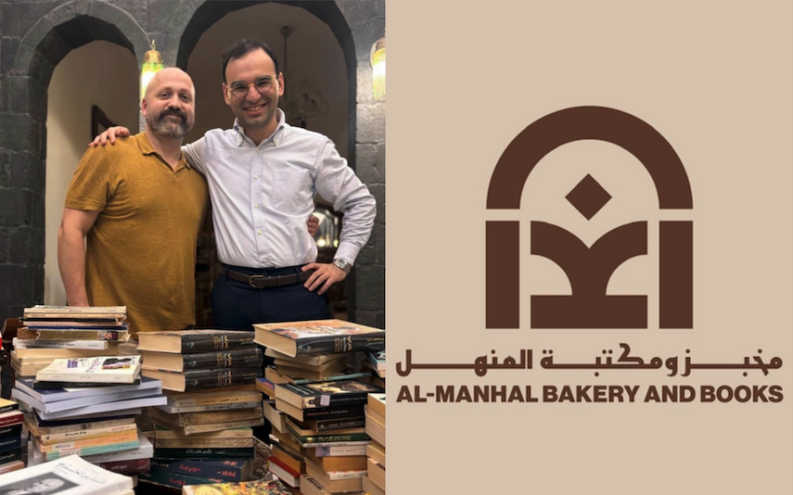

Brant Stewart (l.) and Asser Khattab (credit Asser Khattab).
By Olivia Snaije, Contributing Editor
Glimmers of light and hope can appear in unexpected places. After decades of a brutal dictatorship, a revolution and then civil war, the sudden fall of the Assad regime in Syria in December 2024 gave Syrians their long-dreamed-for freedom of expression despite continuing financial hardship. Thousands of Syrians in exile flocked back to the country to visit, such as Actes Sud/Sindbad’s publisher Farouk Mardam-Bey, who returned to Damascus at age 80, having left the city 50 years ago.Writer and journalist Asser Khattab was one of these visitors who had left Syria in 2017 as a young political refugee, returning after eight years as a French citizen, with the dream of opening a bookshop. Unlike Mardam-Bey, who grew up in Damascus in the 1950s and 60s during a period of cultural effervescence prior to the dictatorship, Khattab’s experience was one of frustration.
“I would spend hours in bookshops and never found what I wanted—serious books that provoked critical thinking.”
Like Mardam-Bey, Khattab grew up in a household where books were all-important. Everyone in his family read, and his grandfather was a writer. He read Arabic classics in his grandfather’s library and western 19th and 20th century classics in English at his missionary school. But what he really wanted to read—contemporary books he read about on the internet—were impossible to find in the numerous yet censored bookshops in Aleppo or Damascus, including ones that carried books in English.
“One day I want to have a curated bookshop,” he thought.
‘We Don’t Know Our Own History’
When the revolution began in 2011, leading to a civil war with ruthless government suppression, Khattab fled first to Lebanon, then to France.
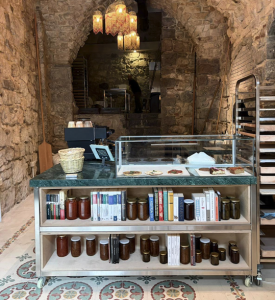
Al Manhal bakery and bookshop in Damascus (credit Asser Khattab).
Last March, Khattab and a partner opened a bakery and library that will become a second-hand bookshop in the old city of Damascus. Al Manhal Bakery and Books is on Straight Street, an axis that dates back to Hellenistic and Roman times and is referenced in the bible.
The idea for the social enterprise came about when a friend that Khattab knew from Beirut met him in Damascus when he returned in early 2025. Brant Stewart, a U.S. photographer, social entrepreneur and part-time Damascus resident who had already opened a social enterprise bakery, Mavia, in Beirut, and he and Khattab thought they might combine their passions.
Khattab had not forgotten his idea about opening a bookshop where events would be held, a space where Syrians could come to learn about their own history and discuss deep issues following 54 years of dictatorship and censorship.
“We don’t know our own history. I only learned about my own history when I moved to France,” said Khattab.
The space Khattab and Brant found had once been a bakery with a wood-burning oven nearly 100 years old. The bakery had been abandoned for years, but after launching a successful crowdfunding campaign, renovations began with an architect who was the former mayor of Damascus’ old city. Classical Damascene tiles were commissioned, and the exposed stone ceiling was restored.
“We are very conscious of gentrification and hipsterization,” said Khattab. “There is a need to innovate but not to stand out in such a traditional place.”
The books Khattab wants to have are not yet widely available, this time not due to censorship but because despite the fact that sanctions have been lifted, the effects are not yet visible. Khattab could have ordered books to be shipped to neighboring Lebanon but with ongoing Israeli attacks on Lebanon and the border between the two countries occasionally closing, this is no longer a viable option.
So far Khattab has a stock of more than 200 books that he has personally curated, with friends of the project physically carrying some books to Lebanon or Syria or leaving others for Khattab in cities such as London or Paris where he has been doing additional fundraising. Khattab has put together a wishlist for books in Arabic as well as in English, because “Some of the best books written about Syria are only in English and haven’t yet been translated into Arabic.”
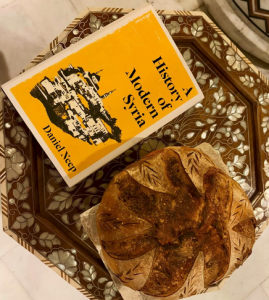
Among his favorites are Daniel Neep’s A History of Modern Syria, and history books by Albert Hourani, Eugene Rogan, and Rashid Khalidi. But, he says, there will also be fiction available.
‘Wishlists’
 At the recent Damascus book fair, which was held in February 2026 for the first time since the fall of the Assad regime, Khattab found nearly 200 books that were on his wishlists, both in English and Arabic, including works by Dostoevsky, Victor Hugo, as well as books of history, philosophy, and political books in Arabic.
The book fair was financed in large part by Qatar and Saudi Arabia, who were the guests of honor. Organizers said that 500 publishing houses were represented, with tens of thousands of Arabic and international titles available. On the first day, 250,000 visitors came to the fair.
According to the journalist Arthur Sarradin, who reported on the fair for the French daily Libération, censorship had been deeply rooted in Syria since the late 1940s, initially targeting history and political books, then works on theology, Kurdish narratives, or Salafist ideology, any of which could land a publisher in prison for six years.
Although religious and self help books appeared to be in the majority at the fair, Sarradin wrote that the book fair closely mirrored Syria itself: “caught in this fragile, sometimes irrational transition. In the aisles, books on Salafist thought sit alongside Hannah Arendt, anthologies by Saudi sheikhs neighbor Fifty Shades of Grey. The dreams of openness brought by young returnees from exile blend with the bling of Gulf conservatives…” As the publisher Gaith Maktabi told Sarradin, “All directions coexist here. Now, it’s up to us to choose.”
Although foreigners, journalists, diplomats, and NGO workers will organically be drawn to Al Manhal, Khattab would like his main audience to be younger Syrians, between the ages of 16 and 24. He is extremely conscious of most Syrians’ limited buying power and says that “books will be treated as second hand because no one can afford to pay $20 for a book besides tourists.”
Al Manhal is first functioning as a lending library until Khattab can ensure he can replenish his stock. Book clubs and discussion groups will be organized, where “the goal will not be to be provocative,” he says, “but to inspire critical thinking and learn about the past.”
Al Manhal already has regulars for the bakery, which produces traditional items with a twist, made with local products. As Khattab says, “Both the bookstore and bakery reflect Syria’s multiple identities. I would like all Syrians to know about their diversity, and its languages that co-exist, whether Arabic, Kurdish, Armenian, Aramaic, or Syriac. It’s so enriching.”
Already thinking ahead, Khattab would like to bring authors from abroad to Al Manhal, such as Eugene Rogan, William Dalrymple or Elizabeth F. Thomson. A number of authors have expressed interest in coming.
Khattab plans to be strict about the quality of the books that will be on offer. “Beggars can be choosers,” he says.