
By Olivia Snaije, Contributing Editor
In 2025, UNESCO published a comprehensive report on the African continent’s book industry, revealing a sector with enormous potential. Egypt, the continent’s third most populous country, showed “remarkable growth” over the past three years, the report stated, expanding its reach and influence in regional and international trade.This may have come as a surprise to Egyptian publishers, who have been battling political instability and major economic challenges for the past 15 years, from the revolution in 2011, to soaring inflation and the recent devaluations of the Egyptian pound in 2023 and 2024.
But herein lies the paradox of the Egyption market: “it is structurally fragile, but culturally invincible,” observes an article in the Arab business magazine EnterpriseAM. “If you look at the spreadsheets, the Egyptian book market should have collapsed. But if you look at the streets, the opposite is happening.”
This was particularly evident at the 2026 Cairo International Book Fair. Despite an economic crisis, a record-breaking 6.2. million people came to the 12-day fair.
Operating on extremely narrow margins, publishers in Egypt never lose sight of their customer, whose spending power has shrivelled. They use endless creative survival strategies to keep their heads above water. In this context, upstart publishing company Diwan, which grew out the established chain of Diwan bookstores in 2021, has forged a creative partnership with French publisher Gallimard’s paperback imprint, Folio, to print French-language novels in Egypt at a price adapted to the customer.
Why print French-language fiction in Egypt?
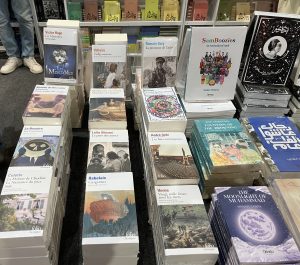
The Diwan/Folio collection at the Diwan stand (credit Olivia Snaije).
With a population of 120 million, there are an estimated three to four million French speakers in Egypt, as well as 50 French schools in the country with more than 5,000 students graduating each year.
“We may be a niche [market], but ours is a very large niche,” commented Brigitte Boulad, who oversees Diwan’s cultural development and its French-language books.
In 2024 Brigitte Boulad and Layal Al-Rustom, co-director of Diwan Publishing, met with the head of Cairo’s French Institute, and together they built a relationship with Anne Assous, head of Folio, and Kamel Yahia, head of exports for Gallimard and Folio’s parent group, Madrigall.
“The idea is simple but very powerful,” said Yahia, who supported the project to make Gallimard’s literary texts could accessible in Egypt, even if his export division wasn’t financially involved with the agreement. Yahia, who has been exporting French books for 20 years, remembers when Cairo—still the largest Arabic book market—was flourishing. “It’s a real market, but it’s held back by pricing,” he said.
The idea of printing a French language collection of books in Egypt came about because “the main cost” of providing access lies in “shipping and converting the price from euros to Egyptian pounds with a fluctuating currency,” explained Al-Rustom. “Also, if the books don’t sell, there’s the cost of returning them.”
Central to the agreement, Assous adds, was the ability of Diwan to ensure proper control over the entire publication process—primarly regarding the security measures taken against piracy when files were sent, but also the quality of printing. It was a “leap of faith,” Assous concedes, “but today we are thrilled. It’s invaluable to have partners like Diwan.”
An Egyptian reading committee made up of academics, in collaboration with Folio, narrowed down a choice from 80 to 30 books to be included in the program’s first batch of books to be published. The list ranges from classics to contemporary fiction including Voltaire, Romain Gary, Simone de Beauvoir, Annie Ernaux, Nathacha Appanah or Marie Ndiaye.
Because Diwan is not only a publisher but also a chain of bookstores with a healthy events program, the 30 books in French that were chosen to start the program will not only benefit from a guarantee of distribution, but also sales to schools and libraries and a French book club held in Diwan bookshops.
Notably, the deal allows for printing and distribution in Egypt only, Al-Rustom specified, adding that 1,000 copies of each book was printed in Egypt, and once all the copies have been sold, the contract must be renegotiated. Diwan also received funding for the project from the French ministry of culture via the French Institute, but Al-Rustom hopes that within three years, the project will fund itself.
A Strong Start
Although it’s too early for figures as the collection launched a few months ago, Al-Rustom said schools and libraries were already buying the entire collection, and that their French book clubs were well-attended.
Although Diwan has made other partnerships in the region, including two one-off deals with Lebanese publisher Dar Al Adab, and a deal to co-publish comic books with another Egyptian publisher, Mahrousa, the agreement with Diwan was a first for Gallimard. If successful in Egypt, Assous said she would be open to replicating the operation in another country—although Gallimard/Folio will not prospect for new partners. “Someone would need to reach out to us and be able to commit and implement locally,” she said.
Meanwhile, Yahia is already exploring other opportunities in Africa. He is leading a project in Algeria that is conducting tests for print-on-demand with a partner who is both a bookseller and distributor.
“The project with Diwan illustrates a new way of thinking about export,” says Yahia. “Exporting isn’t just about volume, it’s also a cultural matter. Our work has no meaning without the bookseller and the reader.”