
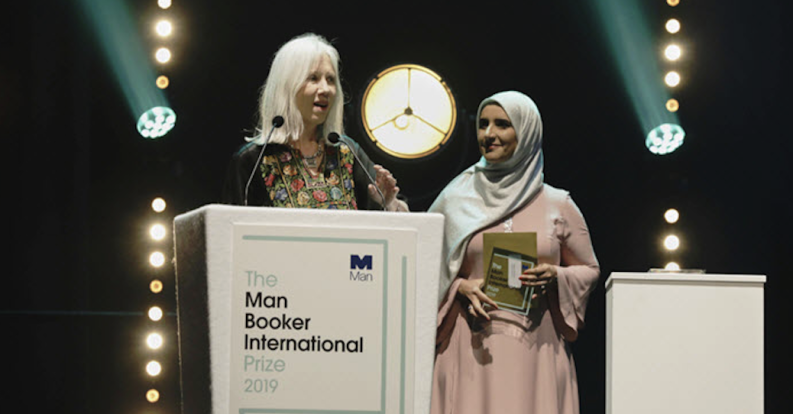

Translator Marilyn Booth (at the podium) and Omani author Jokha Alharthi speak at the 2019 Man Booker International Prize ceremony in London. Alharti’s win is regarded as a turning point for Omani literature (credit: Man Booker International Prize).
By M Lynx Qualey
The way Bushra Khalfan describes the Omani novel, it’s as if the seeds were waiting underground for decades, slowly building up pressure, until a rainstorm swept through in the early 2000s and brought a sudden carpet of flowers. Khalfan, who is part of this sudden flowering, joined a recent panel hosted by Syracuse University Press to discuss “Translating Oman.”The discussion began with the 20th century, when little was heard about Omani fiction beyond Oman. While Arabic short stories and novels became popular in countries like Egypt and Palestine in the late 1800s and early 1900s, the first Omani novel—Abdullah Mohammed Al-Taie’s The Angels of Green Mountain—didn’t appear until 1965. And it wasn’t until 1999 that Badria Al Shihhi published Crossing Embers, which Khalfan calls the country’s first “artistic novel.”

M. Lynx Qualey
And yet, in the last decade, writers from a country of about six million—including about three million Omani nationals—have won dozens of prestigious international literary prizes, including the International Prize for Arabic Fiction (IPAF), the Katara Prize, and the Almultaqa Prize for Arabic short stories. Only one Arab author has won the International Booker: Omani writer Jokha Alharthi.
This success raises two questions: Why was Oman so slow to embrace written fiction? And why have Omani writers now achieved such sudden acclaim?
A Turning Point: the International Booker
According to Khalfan, part of Omani literature’s slow embrace of the novel was a lack of formalized education. “Until 1993, the illiteracy rate in Oman was 41.2%,” Khalfan noted. “That’s the year I was graduated from university.”
This is not to say that Omanis didn’t produce work in other genres. As Jokha Al-Harthi wrote in her introduction to Hamoud Saud’s Raven of Ruwi and Other Stories from Oman, translated by Zia Ahmed, Omani literature has primarily celebrated poetry. Alharthi adds that “short-story collections were not published in Oman until the early 1980s.” After this, Omani novels began to appear. “In Oman, I think we are that kind of people who like to master the craft before we go out with it,” Khalfan said.
This was certainly the case for Khalfan. Born in 1969, she started writing in the 1990s, which is also when she joined the Omani “Cultural Club,” which she described as an “important accelerator or hub.” But it was 2016 before she published her first novel: the acclaimed The Garden We Carry, which is forthcoming in Luke Leafgren’s translation. Her IPAF-shortlisted and Katara-winning Dilshad came just a few years later.
It is not only Khalfan and Alharthi who appear in this sudden flowering of Omani novels. There is also Zahran Alqasmi, who became the first Omani to win the International Prize for Arabic Fiction for his haunting ecofiction, The Water Diviner. There is Mohammed Alyahyai, who won the Katara Prize with his dizzying novel The War. And there are the acclaimed and prize-winning authors Hoda Hamed, Amal Alsaeedi, Mazen Habeeb, and Hamoud Saud.
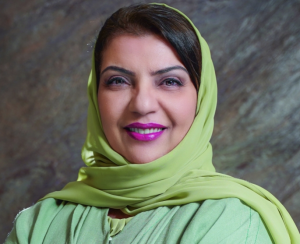
Bushra Khalfan
“The fact that three million Omanis have produced so many books, and literally just in the last decade, is still something that I haven’t quite fully wrapped my head around,” translator Zia Ahmed said during the Translating Oman panel. And yet it is not so much the quantity of Omani literature that is surprising—Arabic literature has seen a boom in many countries in the last decade—the surprise is Omani writers’ sudden, frequent appearances on prize lists, and the Omani novel’s innovation and deft explorations of the natural and historical landscapes.
Abdulaziz Al Farsi’s debut novel Earth Weeps, Saturn Laughs was the first Omani novel to be longlisted for the International Prize for Arabic Fiction, in 2008. In 2013, it also became the first Omani novel translated to English, by Nancy Roberts. Yet it was the second Omani novel, Jokha Alharthi’s Celestial Bodies, translated to English by Marilyn Booth, that would make a massive impact on Omani literature when it became the first—and still the only—Arabic novel to win the International Booker.
This, Khalfan said, was an essential turning point for Omani literature. “Jokha gave us the feeling that ‘you are ready, you can compete, come,’” Khalfan said. “It was a buildup of trust, of Omani self-esteem.”
Still, no full-length translation of an Omani poetry collection has yet appeared in English, nor has a memoir been translated, outside of Sayyida Salma bint Said Al Said’s (known as Emily Ruete) Memoirs of an Arabian Princess in 1888.
Yet already, a surprising number of Omani books have appeared in English since Alharthi’s International Booker win in 2019, including Zahran Alqasmi’s striking Honey Hunger, translated by Marilyn Booth, and Mohammed Alyahyai’s Ishiguro-esque The War, translated by Christiaan James. More are in the pipeline.
The Rising Omani Book Business
The last decade has also seen the appearance of non-government Omani publishing houses and prizes.
Most prominent among them is the UK-based Omani publishing Dar Arab, which publishes works both in Arabic and in English translation. Founded in 2017, Dar Arab has increasingly played a role in creating new opportunities for Omani writers both in Arabic and in translation, publishing the work of several Omani authors, including Younis Alakhzami, Bushra Khalfan, and Badria Al Shihhi, as well as acclaimed authors from elsewhere around the world.
 Perhaps even more significantly, Dar Arab, in partnership with the Bait Al Ghasham Foundation, launched the Bait AlGhasham DarArab International Translation Prize, first granted in 2023.
When it was launched, the prize had two categories: a prize for an unpublished translation of an Arabic literary work and a prize for an unpublished Arabic literary work. In 2026, for the first time, the prize offered a third category, for books by Omani writers. In its first year, the prize received just ten submissions in this new category. And yet the 2026 winner, Mazen Habeeb’s short-story collection Qawanin Al-Faqd (Laws of Loss) was singled out for particular praise by Marilyn Booth.
For many years, Omanis either traveled to Beirut, Baghdad, or Cairo to buy books, or they counted the days to the country’s annual Muscat International Book Fair.
“The book fair is something that we waited for, from year to year, because there were not many bookshops in Muscat,” Khalfan said. “It was our major resource for books, except if we were traveling.” The one bookshop that was around in Khalfan’s youth offered primarily English-language titles. “And then suddenly, one bookshop opened,” she added, “and a series of bookshops followed.”
Perhaps the most well-regarded bookshop currently in Muscat is Qura Al Maerifa. Founded during the pandemic by Ibrahim Al Salti, who manages the bookstore himself, the bookshop is particularly beloved because of Al Salti’s personal recommendations. Omani writer Sharifa Sharifah Alhinai describes it as, “nestled in a quiet residential neighborhood in Ghala, Muscat,” adding that, “Qura Al Maerifa is a cozy independent bookstore that specializes in Omani literature and literature relevant to Omani readers.”
Alhinai also called out a bookshop called Rawazin, founded in 2017 and named after the term for a window display. The bookstore began as a physical shop but is now operates entirely online, specializing primarily in Arabic titles and delivering to Oman and beyond.
There are also a number of smaller bookshops off the beaten path. “There’s a tiny little bookstore that’s an add-on to someone’s house,” Ahmed said, at the Translating Oman event. “You have to know how to get there. But once you get there, it’s just a little room, and it’s packed with books, and whoever’s there is always happy to give you tea and talk to you about whatever is new.”
More to Come
As to what come next, the world should expect more pathbreaking Omani books and more Omani novelists. “I think we will have some new names coming very soon,” said Bushra Khalfan, who is currently supervising a two-year novel workshop, in her final remarks at the Translating Oman event.
Among them, young Omani author Amal Al Saeedi, who won a 2026 Mawred “Production” grant to write what she’s calling The Cultural History of the Grocery Store, a “reflective long-form text that weaves together autobiography and collective memory in Oman, tracing the transformation of the grocery store from a symbol of consumption into a space of fracture and confession.
Also, expect more translation of Omani literature. Several books are forthcoming, including Bushra Khalfan’s Dilshad (translated by Alice Guthrie), with more being pitched by translators. Also, while there is not currently a mechanism for foreign publishers to apply for support of Omani literature in translation, Omani authors can apply to the Omani Ministry of Culture for translation funding.
M Lynx Qualey is the founding editor of ArabLit, a magazine, website, consultancy, and small publishing house. Qualey has won a 2017 Literary Translation Initiative award at the London Book Fair and a 2024 Ottaway Award for the Promotion of International Literature. For more on publishing landscape in Arabic, subscribe to the ArabLit Monthly Newsletter for Publishing Professionals.