


Jen Singerman, Trip Adler, center, and Edward Igushev are co-founders of Created by Humans, a new Ai rights platform from the people behind Scribd. Image: Created by Humans
By Porter Anderson, Editor-in-Chief | @Porter_Anderson
Also today: CCC Announces a Collective Licensing Subscription for AI Systems
‘These AI Companies Want To License Books’
Have a look at the logo you see on the page here. Trip Adler and Jen Singerman want that little insignia to put a new face on intellectual property protected by specific AI rights licenses that verify the content has been “Created by Humans.” Adler, Singerman, and Edward Igushev are co-founders of a new company being developed as an “AI rights licensing platform for creators” and arriving for a launch this year with one more member of the formative team aboard: Walter Isaacson is the company’s founding author and advisor.
Ask Adler about the super-heated controversy between book publishing and generative artificial intelligence firms, and he takes the chance to land on one of his favorite words on the subject: “Our goal here is to bridge the two sides. We’re not trying to get involved in lawsuits, not interested in taking a legal perspective on what’s fair use or not,” Adler says. “We think both sides are doing great stuff, and we want to bridge the two sides.
“Our perspective,” Adler says, “is that publishers and authors are great; AI companies are great; and we just need to build the bridge and they’re going to be working together like a big happy family.
“That’s what we’re working on here.”
 Frankfurter Buchmesse-bound industry trade visitors (October 16 to 20) will have a chance to hear Adler explicate the Created by Humans framework in our 2024 Publishing Perspectives Forum onstage:
10 a.m., Thursday, October 17
Frankfurt Studio in Hall 4.0 just off the Agora
‘Bring the Two Sides Together’
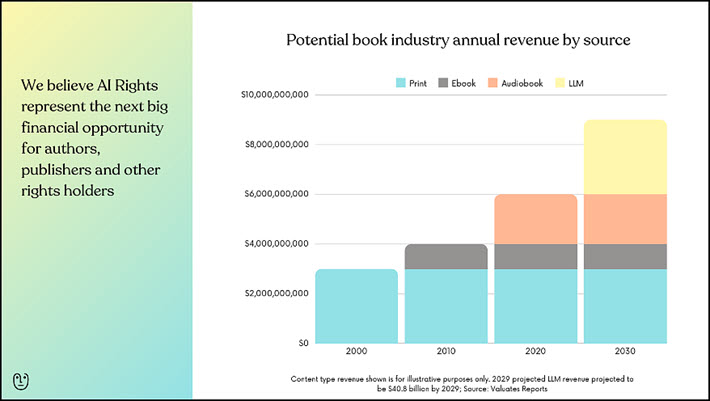
In this graphic, the yellow field seen in the right-most column (for 2029) is assigned to LLM annual revenue, the proposition of Created by Humans being that by 2029, large-language-models revenue, including that from AI-rights licensed content, is projected to be US40.8 billion. Image: Created by Humans, sourcing Valuates Reports
Adler is the Palo Alto-raised entrepreneur who co-founded the international content subscription giant Scribd in 2007. When he decided to step away from Scribd’s top role in October, the self-styled “world’s largest digital library” was reporting more than 1.8 million monthly subscribers in more than 100 countries and an inventory of more than 100 premium titles. In April, Scribd announced that Tony Grimmick, the company’s former CFO would become CEO.
“There needs to be a true marketplace and platform set up for this. Otherwise, it’s going to be a tragedy-of-the-commons situation where a few companies like News Corp get some AI money and everyone else is left out.”Trip Adler, Created by Humans
Adler and Singerman—who was vice-president of marketing and communications at Scribd—are now leading a team of some 10 specialists in engineering, design, operations, and legal matters, to develop what Adler describes in a conversation with Publishing Perspectives as “the intermediary of the marketplace that connects human-generated content with AI companies.
“We think the world needs someone who can sit in the middle and bring the two sides together.”
He concedes that although “we’re trying to be neutral, we’re a little bit more on the side of the humans. We think the human trainers” of LLMs and other learning AIs “need someone to stick up for them. As you know, there’s been a lot of clashing between creators and AI. There’s been all these lawsuits.”
But there also, he says, “are starting to be these direct deals happening.”
One example of this are two arrangements that Wiley has reported making with two “large tech companies,” one for US$21 million and the other for $23 million, in which what the publisher describes to us in answer to Publishing Perspectives‘ query as “a mix of previously published learning and research content” in “deals providing limited rights and use, in this case for model-training purposes.” Wiley has declined to share more details, but this is what Adler and Singerman and their team “think is a step in the right direction,” Adler says.
“But you know, it’s there’s a long way to go because right now, these direct deals mostly are only available to the big companies,” he says. “They’re not being made available directly to creators, and the dollar amounts are pretty small.
“We think this really needs to be built out. There needs to be a true marketplace and a true platform set up for this. Otherwise, it’s going to be a tragedy-of-the-commons situation where just a few of these companies like News Corp get some AI money and everyone else is left out.”
‘These AI Companies Want To License Books’
At its broadest potential, Adler says, he can see AI rights accommodating verticals including “video, music, name-and-likeness data, even medical data.
“The big companies like OpenAI and Apple and Google and others are our potential buyers. We’ve talked to all of them, they’re quite interested.”Trip Adler, Created by Humans
“But we’re starting with books, in part just because I have the contacts from our days at Scribd. But also because we think there’s a really acute problem. We find that these AI companies want to license books. These publishers want to license books to AI companies. And the dynamic is just kind of stuck.”
Getting unstuck involves AI rights, categorized into three groups from which rights holders can choose: training rights, reference rights, and transformative rights.
“We think we can figure out how to solve the problem and get a marketplace going here,” Adler says. “The big companies like OpenAI and Apple and Google and others are our potential buyers. We’ve talked to all of them, they’re quite interested.
“And then there’s also there’s also the long tail. We’ve talked to a lot of start-ups that are interested in this. Universities are interested in this. There really could be hundreds of buyers at this point.”
A Fourth Law for Asimov

Image: Created by Humans
Adler isn’t blinded by science here. He’s clear on the extremes that stand at either end of his metaphorical bridge.
“There’s some folks in Silicon Valley,” he says, “who think all data should be free and the media business should just go out of business because all of this can be produced with AI. And there are creators who think their data is valuable and they never want AI to touch it.
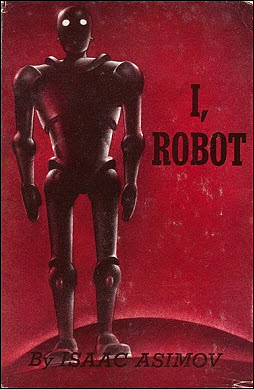
The first edition cover of the collection containing Isaac Asimov’s Three Laws, released December 2, 1950, by Gnome Press
“To bridge these two perspectives,” he says, the team turned to Isaac Asimov’s Three Laws of Robotics, introduced in 1942 in a short story called “Runaround” which was included in the 1950 collection I, Robot.
The first three laws, as Asimov laid them out:
- First Law: A robot may not injure a human being or, through inaction, allow a human being to come to harm.
- Second Law: A robot must obey the orders given it by human beings except where such orders would conflict with the First Law.
- Third Law: A robot must protect its own existence as long as such protection does not conflict with the First or Second Law.
Adler, Singerman, Igushev and their colleagues have formulated one more law to read:
- Fourth Law: When AI robots learn from human behavior or human creative output (i.e. ‘train’ on human data as LLMs do), this must happen symbiotically to benefit both humans and robots.
‘An Arms Race’

Image: Created by Humans
Partly thanks to a $5 million seed investment round led by Craft Ventures’ David Sacks and Floodgate’s Mike Maples with investors including Matteo Franceschetti, Mathew Brezina at Ford Street, Richard Price, Erik Torenberg, and Mark Goldstein of Builders VC, Adler & Co. may be working on a law for humans, too, which says that things have to be easily accomplished.
“We think that by giving the AI companies really high-quality, curated content in a plug-‘n’-play way, they’re going to pay for it.”Trip Adler, Created by Humans
“We have a really nice product,” Adler says, “that allows authors and publishers to use this platform to manage their rights. The product feels like you’re using LinkedIn or YouTube, it’s just a really simple product where you can claim your books, license your rights, and then we’re going to aggregate content and convert this to formats useful for data companies,” basically bundling protected content to meet the needs of the AI companies.
“We’re going to curate it, make it useful to them, and we’ll plug-‘n’-play it for these AI companies. And we think that by giving the companies really high-quality, curated content in a plug-‘n’-play way, they’re going to pay for it.”
And meanwhile, Adler—who shares with Singerman an infectious excitement at being able to parlay what they know from Scribd into this new context—says, “The AI companies are in an arms race right now to try to win, and they have lots of money. And if you can just give them the opportunity to get the best content the easiest way, we think they’re all ready to pay for it.”
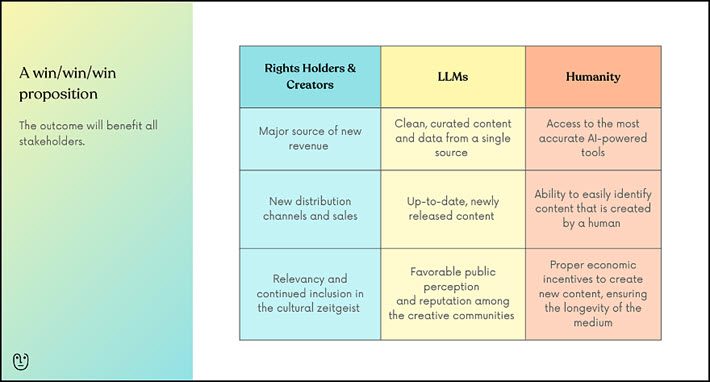
Image: Created by Humans
More from Publishing Perspectives on artificial intelligence and publishing is here, more Scribd and Trip Adler’s work is here, and more on copyright issues in publishing is here.