
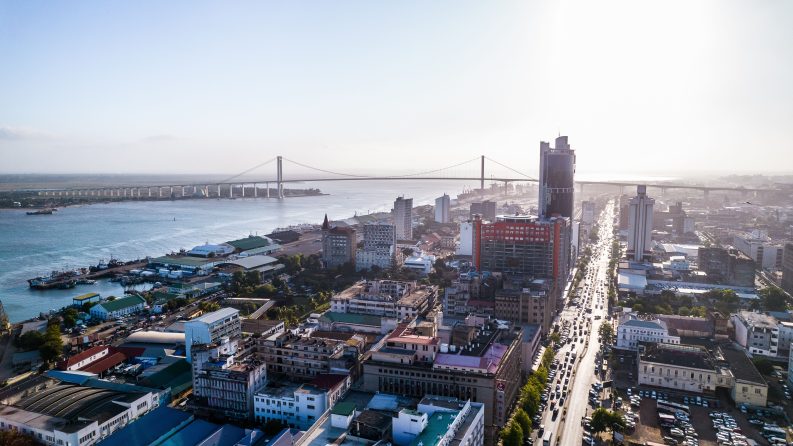
Maputo, Mozambique
By Erin L. Cox, Publisher | @erinlcox

Sandra Tamele, President, Mozambican Publishers and Booksellers Association – AMEL; Founder, Editora Trinta Zero Nove
Publishing Perspectives sat down with Sandra Tamele, President, Mozambican Publishers and Booksellers Association – AMEL and Founder, Editora Trinta Zero Nove to talk about the festival, explore opportunities in the market for international publishers and service providers, and to correct misconceptions about the Mozambican publishing industry.
Publishing Perspectives: Who is the book festival for, and what is its goal?
Sandra Tamele: The Maputo* International Book Fair (MIBF) is designed for both the book trade and the wider public. It is deliberately combining two models that are rarely brought together in Mozambique: a professional B2B book fair, with rights, matchmaking, pitching, training and networking opportunities, and a public-facing cultural and lifestyle event designed to make books visible, attractive and accessible to readers.
Mozambique is approaching 52 years of independence, and we are now seeing a new, native, black generation of writers, publishers, translators, illustrators, editors and cultural entrepreneurs emerging. I feel we have a responsibility to help transform the landscape rather than simply inherit the limitations of the existing one.
Traditionally, what is called a book fair in Mozambique has often been a very modest event: perhaps a tent or an outdoor space, a few publishers or booksellers each given a small table, and limited publicity. These events can be valuable, but they do not create a functioning book market or give the sector the visibility and professional opportunities it needs.
My own experience of international fairs in Sharjah, Frankfurt, Bologna, Cairo and Brazil made me realize how much more a book fair can be. So MIBF is an attempt to bring that experience home and adapt it to our reality.
The ultimate goal is to professionalize the sector and reduce the precarity of publishing and bookselling in Mozambique – to help create the infrastructure, skills, relationships and commercial opportunities that can eventually allow us to speak of a genuine Mozambican book industry.
Can you tell us a little about the publishing market in Mozambique?
Mozambique has a population of roughly 32 million people, spread across 11 provinces, along more than 2,000 kilometers of coastline. It is a young population – the median age is around 18 – and predominantly female. At the same time, we face significant challenges in literacy, poverty and access to cultural resources.
The formal book market is extremely small in relation to the size of the population. Through the Mozambican Publishers and Booksellers Association, we currently identify 27 publishers and seven established booksellers. There are also newer informal and digital players selling books through social media platforms, particularly Instagram. As president of the association, I see it as important to welcome these new players into the conversation: first we need to understand the market and bring its participants together; then we can work towards professionalization and regulation.
One of the fundamental problems is that we do not yet have a complete book-industry ecosystem. Distribution is limited, print runs are generally small, bookselling infrastructure is scarce, and many people working in publishing and bookselling have learned through practice rather than through formal professional training.
There is demand across several segments, including children’s and young adult books, educational publishing, fiction and literature, but the market is highly price-sensitive and access remains a major issue. Print is still dominant, while digital publishing and audiobooks are beginning to create new possibilities, particularly for reaching audiences that traditional distribution cannot easily serve.
For me, this is precisely why the market represents an opportunity. Seven established booksellers serving 32 million people is not only a challenge – it is an enormous potential market waiting for infrastructure and investment.
How can foreign publishers and service providers work with publishers and authors in Mozambique?
There are many opportunities, but the starting point is partnership rather than simply looking at Mozambique as a market for imported content.
Foreign publishers can work with Mozambican publishers through translation and co-publishing, rights exchanges, distribution partnerships, licensing, literary festivals, author exchanges and professional training. Service providers can contribute to areas where our ecosystem is still developing editing, design, printing, distribution, digital publishing, audiobooks, rights management, metadata, marketing and technology.
Translation is particularly important because Mozambique is a multilingual country. Portuguese is the official language, but we also have many African languages spoken across the country. Developing publishing in local languages and developing the capacity to translate between Portuguese and African languages, represents both a cultural and commercial opportunity.
We are also interested in turning literature into an export. Mozambique has extraordinary writers and stories, and I believe books should be treated as one of the cultural products that Mozambique can export, alongside tourism and other goods and services.
This is why we are working with institutions that support small and medium enterprises and advocating for books and publishing to be recognized within Mozambique’s export-development strategies.
What opportunities do foreign companies have to be part of MIBF?
We want international participation at several levels.
Foreign publishers and literary agencies can participate in the professional program, including rights meetings, matchmaking, manuscript pitching, networking and discussions around translation and international publishing.
Publishers can also exhibit and explore rights and distribution opportunities with Mozambican publishers. International organizations, printing companies, technology providers, distributors, audiobook platforms and other service providers can participate through partnerships, workshops, demonstrations and professional sessions.
There are also opportunities for cultural partnerships and sponsorship, particularly around bringing authors, illustrators and publishing professionals to Mozambique, supporting children’s programming, translation initiatives and professional development.
The important point is that we don’t want international participation to be purely symbolic. We want people to come to Maputo, meet the market, understand its realities and identify concrete ways of doing business together.
MIBF is therefore not only an event where Mozambique presents itself to the world. It is intended to become a platform through which international partners can enter into meaningful relationships with the Mozambican and wider Southern African book markets.
What would our readers be surprised to know about the Mozambican publishing industry?
Perhaps the biggest surprise is the scale of the gap between the size of the population and the size of the book infrastructure.
We have roughly 32 million people, but only 27 publishers and seven established booksellers. There are 11 provinces, yet access to books outside the major urban centers is extremely limited. I live in Marracuene, just outside Maputo, and until I opened the Livroteca* there in November 2025, the town did not have a bookshop nor a public library.
That tells you something about both the challenge and the opportunity.
Another misconception is that the absence of a developed industry means there is no talent or no appetite for books. Quite the opposite. There is an extraordinary amount of literary and creative talent. What is missing is the backbone that allows that talent to become an industry: distribution, professional training, investment, data, infrastructure, rights expertise, marketing and access to international markets.
I often say that we need to stop treating books only as a passion and start treating publishing and bookselling as businesses. Of course books are cultural products, but they are also economic products. Writers, illustrators, editors, translators, publishers, printers, booksellers and distributors all need sustainable livelihoods.
That is ultimately what MIBF is about. We are not simply trying to create a bigger book fair. We are trying to create the conditions for a book industry to emerge.
For more information about MIBF or to participate, please email amelmaputo@gmail.com.
*Maputo Metropolitan Area comprising Maputo, Matola, and Marracuene municipalities.
**The name combines Livraria, Bookshop in Portuguese, and Biblioteca, Library.