
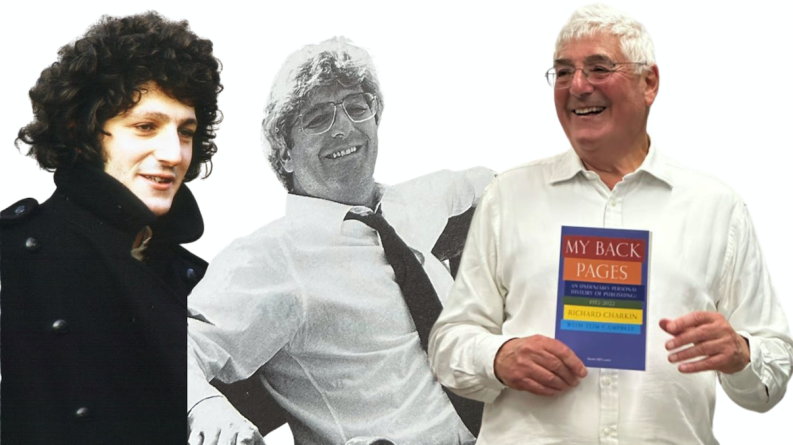
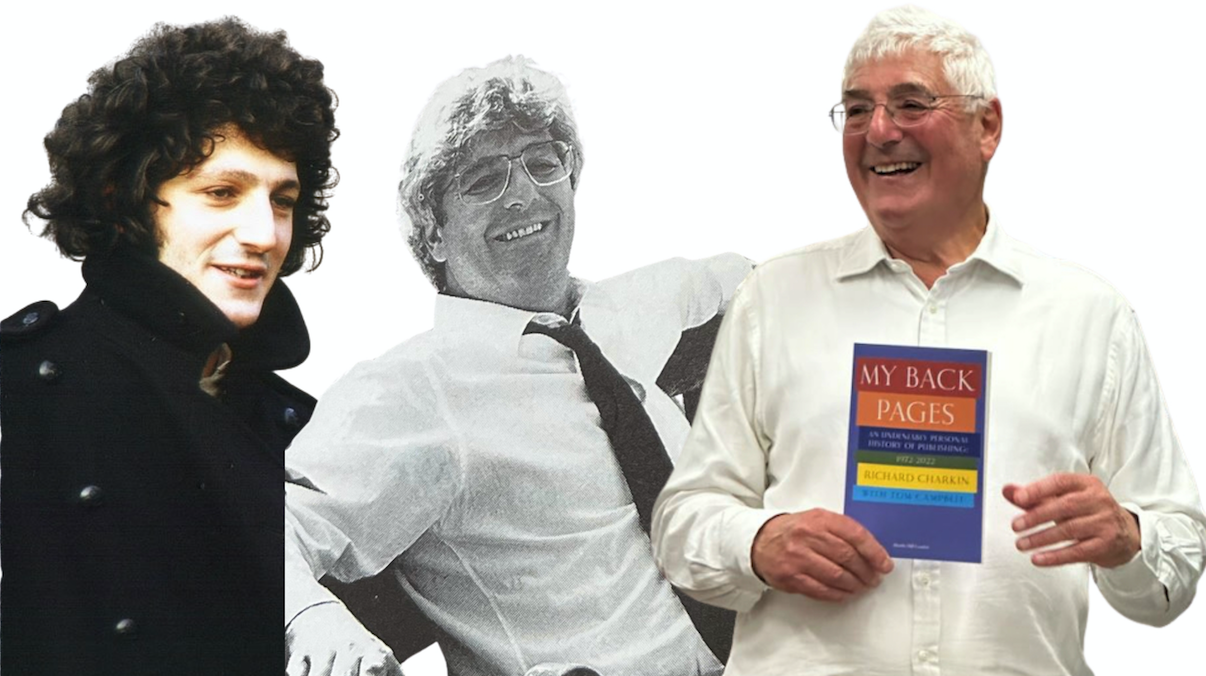
The three stages of Richard Charkin: Early in his career, mid-career, and late career.
By Richard Charkin, Columnist
One of the first books I published under my own imprint, Mensch Publishing, was Getting Old: Deal with It, by Lee Janogly, who is still “dealing with it” even as she approaches her nineties. I am still dealing with it as well. I started a new role as Chair of Thames & Hudson Ltd at the veteran age of 76. I was “interviewed” for this job by the (sadly) late Thomas Neurath’s two daughters, who jointly oversee the owners’ interest in the company.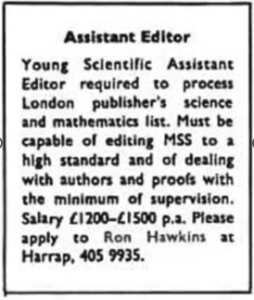 The first time I interviewed for a publishing job was in response to the ad, pictured to the right. Notice the use of the word “young.”
That term—young—was then (and still is) a euphemism for “low cost.” In contrast, the word “experienced” in job ads is a euphemism for older. By the way, I ended up accepting the job for £1,200 a year—the bottom end of the range—and I have never regretted not asking for more.
Recently, it occurred to me the “interview” with Thames & Hudson may well have been my last job interview, which has prompted me to reflect on how older, experienced people are often treated in our industry.
In our business, a successful career route might look like this: You start as an intern. You eventually land a job as a home sales rep. From there you become regional and then national sales manager, running a team of reps. In time, you take on more duties, perhaps responsibility for foreign sales and rights. And, after a hard battle to convince the CEO that sales and marketing should be combined under your leadership, you are named sales and marketing director.
Of course, by this time you are now in your early sixties with little chance of becoming CEO. In fact, your corporation, which has now become part of a larger corporation, has already decided to bring in a new CEO from outside the organization, someone with new ideas and a different skill set from traditional publishers, like you. And soon after, your salary and benefits catches the attention of this newly appointed CEO as a potential cost saving in the overheads, which they have promised their investors they would deliver.
So, off you go with a severance payment and, hopefully, a decent pension pot. It’s okay—you won’t starve, and you continue to have a good and fulfilling life. Perhaps you even find yourself thankful for having been so generously laid off.
Also not atypically, the new CEO’s ideas for a radical transformation of the business turn out to be a mistake. Sales don’t increase as predicted and the overhead cost reduction plan turns out to be harder to implement than anticipated. In near desperation to cover up the company’s misfortunes, the CEO makes a ‘courageous’ acquisition—maybe a company, maybe a big-time author. But that move also proves unsuccessful, and the CEO loses their job.
If this sounds familiar, I suspect it’s because this is the way of the corporate world. But, I wonder, might there not be an alternative? Does a career progression in the publishing business always need to be a one-directional, upward climb?
Rather than pushing them out, what if more publishing leaders today considered finding ways to retain and redeploy talented and highly experienced employees, like our sales and marketing director? Perhaps there’s an opportunity to help with other parts of the business, or, maybe to simply return to being a rep who can mentor and train new recruits. Or, why not the option to move to a reduced schedule and a narrower job description, or even to change roles altogether, maybe as an operations or HR consultant? After all, the industry’s most experienced employees probably know more about the challenges, opportunities, and training necessary in a publishing business than most HR specialists.
Don’t get me wrong, I am the last person to propose any element of positive discrimination, and that’s not what I’m proposing here. But might it not be an idea for publishing companies to keep employees in some capacity rather than send them off with a slight but real feeling of corporate disloyalty tainting their retirement? And might it just be possible that experience still counts for something in publishing’s rapidly changing business and social environment?
I am extraordinarily lucky that I have been able carve out a career and a post-corporate life involving many parts of the publishing business. But I know many are not so fortunate.
All publishing careers are different, of course. But while we’ve rightly heard much more in recent years about how difficult it is for young people trying to break into the business, consider this a plea for industry leaders to also consider the careers of those at the other end of the spectrum. Thinking creatively about how to effectively—and, of course, cost-effectively—harness the experience of long-serving publishing professionals could potentially benefit everyone: the career employee who has dedicated their professional life to our business; the company, which would see a better return on their investment; and new employees, whose young careers would benefit from the institutional memory and mentorship of their experienced counterparts.