
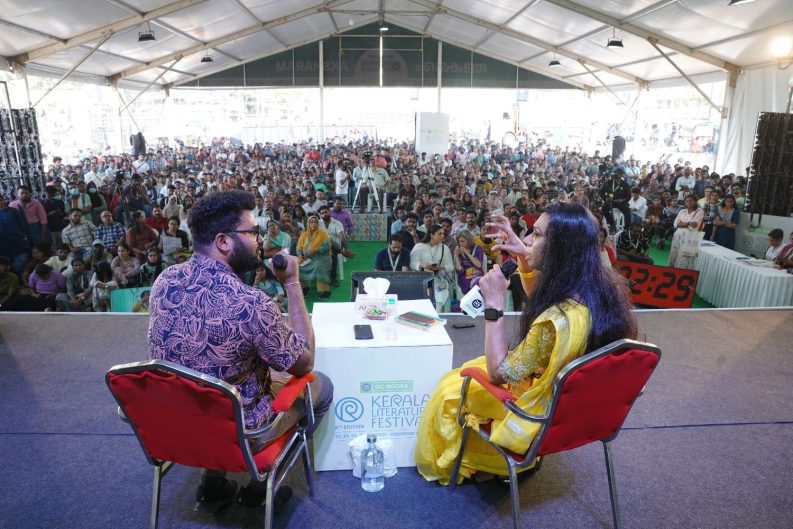
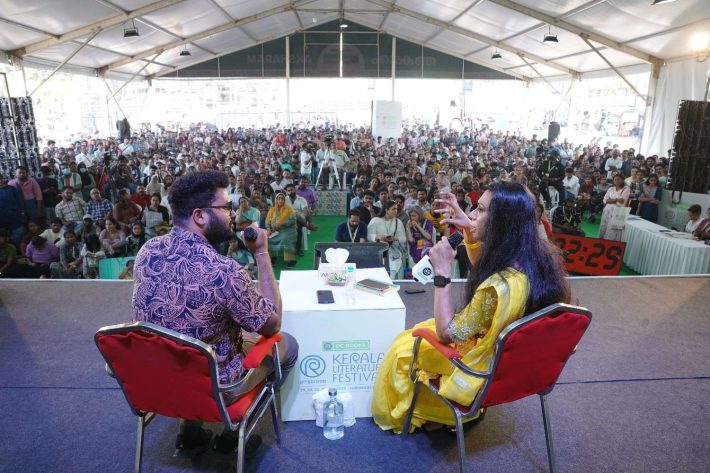
Akhil P Dharmajan and Seethal Syam on stage at the Kerala Literature Festival, Photo courtesy KLF
By Arpita Das
Now that “litfest” season is beginning to wind to a close in India, this is a good time to take stock of an odd little kerfuffle that erupted recently.In January, The Guardian ran what seemed like a piece written on the back of a gaggle of Meta searches called Most Indians Don’t Read for Pleasure—So Why Does the Country Have 100 Literature Festivals? After a robust backlash, which included social media outrage as well as response pieces on almost every online platform as well as in some mainstream print media outlets, the headline of the same article was altered to Music, Bollywood stars and a party vibe: why India’s literature festivals are about so much more than books.
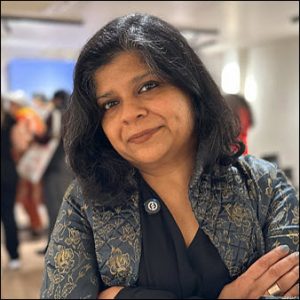
Arpita Das
To me, the change in the headline was a dead giveaway of how indefensible the central argument of the piece was. But it was also a reiteration of a fact I go blue in the face teaching in my critical thinking classroom at university: that simultaneous truths almost always exist.
One does indeed often come across the phrase “litfest fatigue” on social media posts as well as other, more serious pieces of writing on a phenomenon to which we were all introduced to in the early 2000s: the literature festival. I too feel a fair bit of cynicism when I see how unoriginally most of the well-known litfests in the Indian metropolises seem to be planned, often scheduling panels whose central provocations are humdrum enough to reduce even bright-eyed creative writing undergraduate students to soporific somnolence, and then making it worse by repeating the same set of writers across the panels over consecutive years.
Sadly though, the unsuspecting subject of this cynicism is an even more recent phenomenon: litfests organized in small towns and localities in the country, often building on the shoulders of similar events being organized at local public universities in the immediate aftermath of the pandemic. I say sadly because these smaller events should not be at the receiving end of such privileged sneering.
The Litfest Culture
The modern international litfest was first imagined in the West in the 1980s as an effort to build local book cultures, with entire neighborhoods coming alive with in-person reading groups and writing communities.
This is precisely how they began to be organized in India as well, in the first decade of this century. With growing neo-liberal interest, however, they quickly evolved into the diasporic writer’s wet dream: visiting the erstwhile land of red earth and pouring rain for some desi acclaim. With time, and an infusion of corporate money, a handful of litfests became the Best Exotic Marigold experience for western literary icons.
However, smaller literary festivals located far from the metropolises usually do not have the budgets or the infrastructure to attract the diasporic or foreign writer. Here, organizers dig deep to find writers in their proximity, via word of mouth or by speaking to students at the local university department, or via consultations with local publishers working with languages spoken and written in that region.
The result, if you happen to make the time to visit one of these low-key litfests, is that you are fortunate enough to listen to rousing sessions where indigenous community writers talk about their ‘dialect’ informing the style they write in for a larger, more diverse audience; local novelists reading their favorite chapters in languages other than English; immersive sessions where translators speak about the challenges they face while trying to keep the texture and nuance of their language alive in transferring the narrative to another one; and writers who focus on issues that matter most immediately to the reading community that gathers at these spaces. What’s not to love?
At a litfest organized by a private liberal arts university in the Delhi-National Capital Region, I recently happened to be on the same panel as a highly respected feminist publisher. The panel was on Emerging Publishing Ecologies, and something she said about the rationale for all litfests, big or small, glamorous or local, even though they might seem self-indulgent to some, struck me as why we should keep championing litfests: That, very often, these are the only spaces where young, aspiring, entirely green writers can have access to established writers. The only spaces where, while getting a book signed, or during a Q&A session, or just brushing elbows at the lunch counter, they can end up having a conversation which becomes decisive in their journey to pursue a craft that takes time and effort to hone. Sometimes, a session might even introduce a voice to a young person that they had never heard before.
Frankly, there can be no better reason to keep having all sorts of litfests. These events give young people from different backgrounds, including those who are not flush with social capital, access to the most sought-after voices in writing.
It would be important to remember, however, that access is also about the space in which litfests are organized. Over and over, the biggest litfests in the country will advertise their event as free and open to all, entirely whitewashing the fact that they are being held at a heritage hotel, or a five-star resort, or a members-only cultural club. One can only imagine how free and open these spaces would really be to young people aspiring to be writers who happen to be from the “wrong side of the tracks.”
There are some honorable exceptions, though. The Kerala Litfest which takes place on the wide, open Calicut Beach; the litfest which accompanies the legendary Kolkata Book Fair; and the Kala Ghoda Arts Festival across multiple public venues in Mumbai.
May their tribe increase. And may we have more litfests like these, which are truly the cultural commons they were meant to be.