
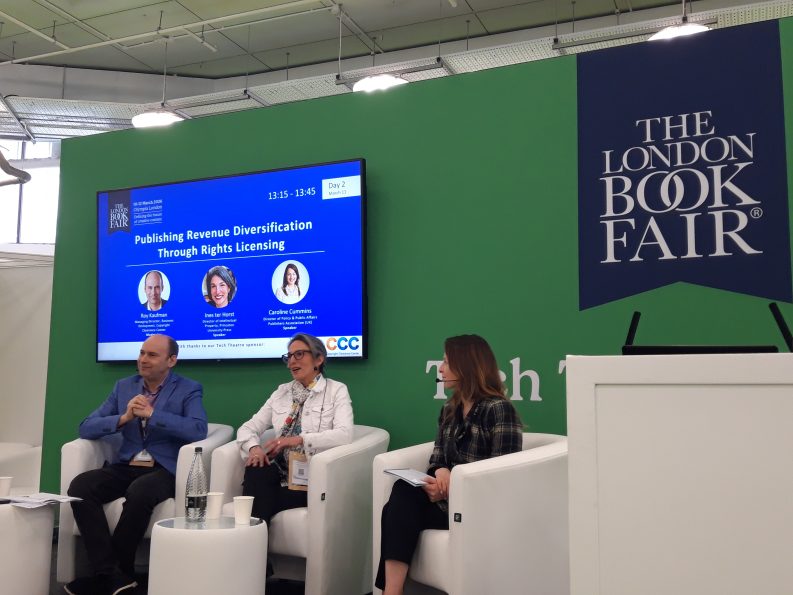

L-R: Roy Kaufman, Inés ter Horst, Caroline Cummins (Photo: Publishing Perspectives)
By Erin L. Cox and Meike Eckern
“Rather have a bad license than no license. Don’t be precious.”
Publishers focusing entirely on revenue only from book sales or journal subscriptions is leaving money on the table, particularly today with the creation and training of LLMs.In the panel “Publishing Revenue Diversification Through Rights Licensing” at the London Book Fair yesterday, Roy Kaufman, Managing Director, Business Development for Copyright Clearance Center moderated a discussion with Ines ter Horst, Director of Intellectual Property at Princeton University Press and Caroline Cummins, Director of Policy & Public Affairs at the Publishers Association to help publishers and authors understand the opportunities in existing markets while also exploring new revenue sources.
Expanding to new markets is a focus for Princeton University Press, says ter Horst, stating that they seek to translate voices not just publish U.S. voices. Their partnership with Planeta allows them to publish Spanish and English titles simultaneously and has had growing success.
One of the challenges for expanding to new markets is that not every country has the same relationship to copyright that the United States or United Kingdom has, so keep in mind the three Cs – consent, credit, and compensation.
Kaufman emphasized respect. The industry is not looking to prevent the spread and use of content and the more licensing publishers do to help make content more accessible to researchers, the less piracy there will be.
Unsurprisingly, AI and licensing was a big topic. While publishers and authors continue to battle their way through the legal system with AI companies that used pirated copies of their books, there are other companies (beyond just AI companies) who are looking to actively license high-quality content to not only build but help train their LLMs.
Publishers who are watching those lawsuits closely may be hesitant to license their books, but Cummins noted that publishers have been licensing content for text and data mining (TDM) for a decade.
That information is in a report that came out last week from the Publishers Association, Content Superpower: UK publishing and the AI licensing market. The report is the first comprehensive account of how books and journal publishers in the United Kingdom license content for use in AI.
The report highlighted how long publishers have been licensing content and that licensing for Retrieval-Augmented Generation (RAG) is now a meaningful and growing part of the market.
The number of publishers active in the licensing market, which includes all major academic publishers, is set to double this year.
One thing the panel clearly noted is that if publishers do not get into the game, they will not have any bargaining chips to negotiate in the future. And, the more publishers participating, the more power and control the industry has collectively in these negotiations.
“Please license,” says Kaufman. “Rather have a bad license than no license. Don’t be precious. Promote what you’re doing and do it publicly.”
The more transparency there is for the process and these licensing deals, the less likely tech companies can pirate books and ignore copyright.