
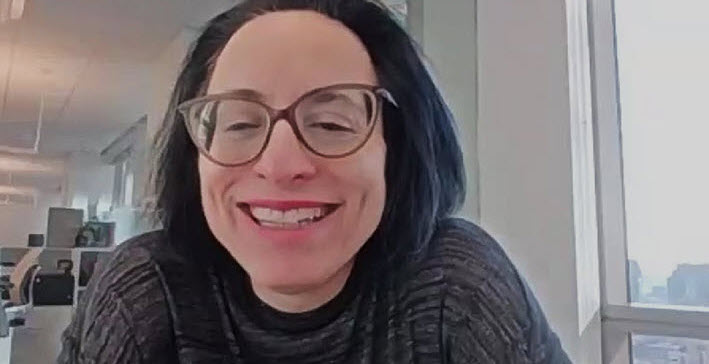

Kristin Fassler, senior vice-president and director of marketing strategy at Penguin Random House, in conversation with Publishing Perspectives
By Porter Anderson, Editor-in-Chief | @Porter_Anderson
Kristin Fassler: ‘We Have a Fragmented Audience’
As Publishing Perspectives readers know, the Center for Publishing and Applied Liberal Arts at New York University’s School of Professional Studies‘ has opened registration for its 2025 NYU Advanced Publishing Institute for book business professionals. Designed for mid- to senior-level book-publishing professionals, the program will take place as a physical event at New York University’s Kimmel Center on Washington Square South. Information about the 2025 program and registration is available here and through email at nyu.api@nyu.edu. The US$5,000 fee includes breakfasts, lunches, and opening and closing receptions.
On January 9 at 3:45 p.m., Penguin Random House’s senior vice-president and director of marketing strategy Kristin Fassler will be joined by Amanda Orenstein, PRH’s senior manager of strategic insights for Knopf Doubleday, in a presentation called Shifting Consumer Tastes in Social Media.
Anyone who remembers when “BookTubers” were thought to be the future of book marketing now knows the lessons of TikTok and Instagram and other dynamic systems that can come into focus in different marketing scenarios, sometimes even operating in tandem with each other.
At the NYU Advanced Publishing Institute in January, “We really want to talk about how to tap into trends and capitalize on them, and how to find those trends online.”Kristin Fassler, Penguin Random House
“Some of it,” Fassler says, “is how you find trends on social [media] and activate around them, but some of it is also just in general—how you engage people on different platforms.”
Fassler sees the issues here in a holistic way in terms of social-media focus. “We have a kind of roadmap,” she says, “that we want to follow, and I’m excited about it because we don’t want to be repetitive, but we do want to be actionable.”
That most valuable quality of so many good conference sessions—actionability—in this case means that Fassler and Orenstein feel that, “We can definitely talk about social, but that might be a little too small. Sure, there are things you can find on TikTok and I have some good examples, but there’s a lot more to it than that.
“We really want to talk about how to tap into trends and capitalize on them, and how to find those trends online. There’s other things like Google and consumer review data. I don’t want to think about social in such a small way because”—she pauses to reach for a piece of paper as she talks, liking what she’s coming up with–”it’s about every way that you engage with people online.”
A vivacious conversationalist, Fassler is quick to the mark as she warms to her topic. When it’s noted that while so much of the trend-spotting she’s known for is based online, the question arises about how many things in the online framework can be corrupted by disinformation.
“At least much of that may not be directed toward publishing,” her interviewer says.
“Well, I don’t know,” she says. “We just got sued.”
She’s referring to the warning letter sent to The New York Times and Penguin Random House from Donald Trump, threatening lawsuits for allegedly defamatory writings by some Times reporters who have had books published by PRH. Even as she works with a quite political author about the messaging around the book’s advertising, she says, “You have to wade into the political mess” at a time when the backdrop of so much simply is political.
‘I Think AI Is Amazing’
Where she and Orenstein—”my analytics person”—are looking to go with their talk in January at New York University is toward the most tangible advice they can offer to the Advanced Publishing Institute’s participants: developing trends “into action in their day-to-day jobs. I also understand that not everyone has the resources that PRH has. So Amanda and I want to give people very specific tools that they can use, and examples of how we did things that they could emulate.
 “Years ago, I worked on this book called Salt Sugar Fat: How the Food Giants Hooked Us“ by the Pulitzer Prize-winning reporter Michael Moss. “And we thought that Salt Sugar Fat was going to be for people who were interested in their own diets, right? But what we saw was how much traction this subject was getting with parents” concerned about their children’s diets, “so we pivoted and marketed to parents.”
This is the kind of example that Fassler has plucked from her experience both at Penguin Random House and during her time at Simon & Schuster.
When asked what she thinks of artificial intelligence, she says that while much care and concern must go toward protecting creative use from inappropriate “training” of generative LLMs using copyrighted material without permission, “I think AI is amazing,” she says.
“I was working before the Internet, and I feel that AI is more transformative than the Internet was to my day-to-day job.”
In the realm of trends, she says, “One of the things we’re going to talk about at NYU is that AI tool on Amazon that consolidates consumer reviews.”
She’s referring to the “Customers Say” tool for consumers on an Amazon sales page—you can find it just to the right of the Customer Reviews rankings. “Customers Say” takes both positive and negative consumer commentary on a product and coalesces this into a paragraph of pros and cons. For example, here’s the “Customers Say” note on the 2014 release that Fassler has referred to, Michael Moss’ Salt Sugar Fat:
“Customers find the book compelling, excellent, and fun to read. They describe the information as well-researched, enlightening, and accessible. Readers also find the content terrifying, disturbing, and shocking. They describe the presentation as well-presented, impressive, and eye-opening.”
“I spend a lot of time on these,” Fassler says. “This is one of the trend things we’re going to talk about. I delve into Amazon consumer reviews to understand what’s motivating book purchases, and that little snippet that Amazon does is really helpful. I use AI consistently throughout my day. It’s so helpful. I do think it’s the most transformative thing I’ve ever seen in 30 years of working.”
‘What Do We Do Now?’
If the arrival of tasks that AI can perform to highlight new angles and motivations is a boon, Fassler also points to a perplexing element of marketing today that’s generating some concern, and this, too, is likely to have some presence in her session with Orenstein. Here’s a look at why Fassler’s candor and collegial honesty is so appreciated by her colleagues.
“All the things that we know how to do aren’t working in the same way they used to. I think this is because we have such a fragmented audience.”Kristin Fassler, Penguin Random House
“The thing that has been really a struggle this past year,” she says, “is that all the things that we know how to do aren’t working in the same way they used to. I think this is because we have such a fragmented audience, it’s so distracted and getting information in so many different ways.
“I’ll give you an example” without a title, or “without throwing a specific book under the bus,” as she puts it.
“I would say the one thing that I really know how to do is market up-market women’s fiction. I had a book this year that was set up in the most perfect way possible, and really delivered as a book. And it did not work. And it was very destabilizing for me, because that is what I know how to do.”
Rather than look at this misfire as a fluke, trends-minded marketing specialist that she is, Fassler has taken on this case as a mystery to be solved. “I’ve been interviewing the whole marketing staff,” she says, “and a lot of people are telling me they don’t feel they can experiment, because they have to do ‘what works.'”
Clearly, when “what works” doesn’t work, it’s time to rethink things.
“So I had a team-wide meeting today,” she says, “and I told them, ‘I want you to experiment, because we don’t know what works anymore. I don’t want you to tell me you’re doing what works, because I don’t see that it’s working. I want you to think about other things.’ “What do we do now? Because the things that we always did are not as successful anymore.”
‘I Never Want To Be Subtle’
This concept of the highly distracted, info-overloaded audience is something many are facing in many markets and many industries.
“TV and movies are struggling, too,” Fassler says. “There have been some great book-to-TV properties lately. [But] people are disconnected and distracted and not talking to each other as much. There’s just so much information flying at people from so many different angles.”

Andrea Chambers
While some publishing executives might feel at least a mild depression when faced with a dilemma about the high wall of distractions now standing between marketers and customers, Fassler sees it as a testament to the flexibility and authenticity of the program put together by Andrea Chambers, the associate dean at New York University’s Center for Publishing and Applied Liberal Arts, working with Georgina Levitt.
“I’m excited,” she says. “I think it’s a little bit different from what the expectation was, but I hope we can give people some real actionable steps they can take because because when I went to Simon & Schuster, I didn’t have all these resources available to me, and I was still able to do a lot of this research and kind of capitalize on trends.”
At the Advanced Publishing Institute, participants will hear and see Fassler do what she’s best at: thinking around the corner—not necessarily in the direction people might expect her to go—in order to explore how to better discern the trends impacting customers, and get the books into their hands. That, she knows requires understanding who the reader is and what they need to know to buy a book.
“For every book, we’re very clear about who the reader is and what the experience we want them to have with it is,” Kristin Fassler says. In matching that experience to the right customer, “I never want to be subtle, ” she says. “Subtlety? Forget it.”
More on events in New York University’s programming relative to book publishing is here, more on registration is available here, more on publishing education is here, and more on the United States’ publishing market is here.