
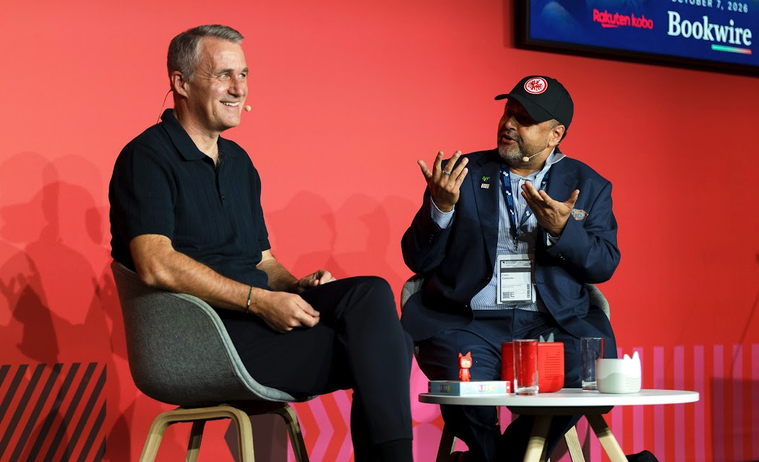
The author (right, in an Eintracht Frankfurt hat) during a playful moment with tonies CEO Tobias Wann during the CEO talk at the 2026 Frankfurter Buchmesse.
By Carlo Carrenho, Contributing Editor
Seen from a distance, the publishing industry today can look much the same everywhere. Artificial intelligence dominates the conversation, bringing anxiety, curiosity, and resistance in roughly equal parts. Bookstores are under pressure in many countries, feeding debates over public policy, pricing, and physical discovery. Audiobooks keep growing too, a true bright spot, though at very different speeds depending on where you look.But it’s some of the outliers that show just how unique the global book business still is—stories about developments shaped by a market’s own conditions, policy choices, cultural habits, or technological prowess.

Carlo Carrenho
China, for example, is such an outlier, a market where even the basic vocabulary of book retail is changing. In most markets, sales are still split between physical bookstores and online channels. But OpenBook’s recently published Book Retail Market Trend Insights Report draws a sharper line: shelf-based retail vs. content-driven e-commerce. Shelf sales cover the physical and digital spaces where readers actively browse and choose books; content-driven sales come through short video, livestreams, and algorithmic discovery, mainly on Douyin, TikTok’s Chinese sister app.
According to the latest figures, China’s overall book retail market fell 2.24% in 2025. But content-driven e-commerce grew 30.43% and reached 40.53% of the market, overtaking shelf-based retail for the first time. This is more than a shift in sales channels. It suggests a market where discovery itself is being reorganized.
Japan is another clear outlier, starting with the sheer weight of manga. A Publishing Science Institute analysis of the 2025 market split it into three parts (comics at 44.8%, books at 39.9%, and magazines at 15.3%). But the bigger shift in Japan may be strategic. METI, Japan’s Ministry of Economy, Trade, and Industry, wants to raise overseas sales of Japanese content from ¥6.1 trillion (about $38.9 billion) in 2024 to ¥20 trillion (about $127.6 billion) by 2033, with manga alone targeted to grow from ¥300 billion (about $1.9 billion) to ¥1 trillion (about $6.4 billion).
To get there, Japanese publishers no longer seem content to just license intellectual property abroad and let others build the international business around it. Media Do has acquired Seven Seas; Shueisha has launched MANGA MILLION in more than 100 languages; Kodansha is bringing manga properties into Roblox; and platforms such as emaqi are giving Japanese publishers new ways to reach North American readers directly. Japanese publishers aren’t just exporting their stories anymore—they are traveling with them.
The Nordics and Beyond
The Nordic markets are an outlier of a different kind: audio isn’t just a growing format there, it’s the backbone of the market. Sweden makes that clearest. Based on 2025 data from the Swedish Publishers Association and the Swedish Booksellers Association, audio accounted for 61.1% of all units sold and 29.7% of total market value. Audiobooks made up 92.2% of digital units and 91.8% of digital revenue. And about 98% of digital sales value came from subscription services.
Sweden isn’t really a print market with a digital audio segment attached—it’s a subscription-driven audio market that still happens to sell a lot of print. That’s why platform moves matter so much there: Spotify began offering audiobooks in Sweden in November 2025; Audible is expected to launch a localized Swedish store, and on September 1; Bonnier Books, owner of BookBeat, agreed to acquire Nextory.
Poland, meanwhile, is a different kind of audio outlier. Poland’s audiobook market was estimated at about US$61 million in 2024, up 20.4%, with a catalogue of roughly 40,000 titles. But if Sweden shows what happens once subscription audio becomes market infrastructure, Poland shows how crowded the platform layer can get while a market is still developing. The country already has Audioteka, Empik Go, Legimi, Storytel, and BookBeat, with Audible also preparing a local operation.
Now comes Novelist, launched in September after approval from Poland’s competition authority, UOKiK. What makes Novelist unusual isn’t that it’s another subscription service for ebooks and audiobooks—it’s who’s behind it: eight Polish publishers and the publishing and distribution group Dressler Dublin. Publishers banding together to build their own retail operation is rare, especially with regulatory approval, and a stated openness to bringing in others.
Brazil’s outlier runs almost the opposite way: not platform density, but the sheer weight of government purchasing. In 2025, Brazil’s total book market was worth about $1.31 billion, with government sales accounting for roughly $402 million—close to a third of the whole market.
That creates an unusual dynamic, where trade publishing, educational publishing, and public policy are never fully separate conversations. And the digital library platform MEC Livros, created by Brazil’s Ministry of Education, fits right into that picture: it’s an attempt to build national digital reading infrastructure by tying together access and public procurement. In most markets, digital platforms are built first by retailers, audio companies or tech players. In Brazil, a major digital book platform is being built by the state.
Spanish-speaking Latin America offers several interesting outliers. The first is BuscaLibre. Born in Chile and now active across several countries, it has become something rare in global publishing: a book-focused online retailer built from within the region, offering an Amazon-like alternative in markets where catalogue availability, logistics, and cross-border supply are constant headaches.
The second is regulatory. Across the region, the book debate keeps coming back to public policy—particularly the fixed book price—but also support for bookstores and public purchases. Mexico is a recent example: after the collapse of Ediciones Era, pressure from the book sector helped bring new support measures for publishers and booksellers, including a proposed tax change for bookstores. In a fragmented region, the search for healthier markets is happening both through private retail infrastructure and through renewed calls for regulation.
In Europe, Portugal is a rare exception of market growth. Data from APEL, the Portuguese Association of Publishers and Booksellers, showed the book market growing 7.6% in value and 6.9% in units in 2025, reaching about €217.5 million ($255.3 million) from sales of 14.8 million books. With inflation around 2.3%, that works out to real growth of roughly 5.2%.
The contrast with the rest of Europe is striking—Germany’s print market fell by roughly 5% in real terms, while France fell by about 1.9%. At the same time, much of Portugal’s growth came from the exceptional performance of coloring books, and APEL warned against mistaking a cyclical trend for a structural recovery in reading. Still, in a difficult year for European publishing, selling more books and making more money at the same time stands out.
Meanwhile, Spain supplied one of the year’s most unexpected outliers: An airport operator has become one of the most ambitious literary patrons in the Spanish-language world. Aena, the 51%-state-owned airport operator, launched the world’s richest prize for a single work of fiction, the Premio Aena de Narrativa Hispanoamericana, offering €1 million to the winner and €30,000 to each finalist.
The inaugural prize went to Argentine author Samanta Schweblin for El buen mal. Aena also committed to buying thousands of copies of the shortlisted books for its employees, schools, libraries, and cultural centers.
Despite globalization, and despite extraordinary advances in technology and communication, the book world hasn’t become the same everywhere. Publishing markets share many of the same pressures, but they keep developing their own quirks, habits, and surprises. Which is a good thing. Difference is what makes us human. And difference is what keeps publishing dynamic, and fun, and ultimately, alive.
A version of this article appeared in the Publishing Perspectives print magazine at the 2026 Frankfurter Buchmesse.