
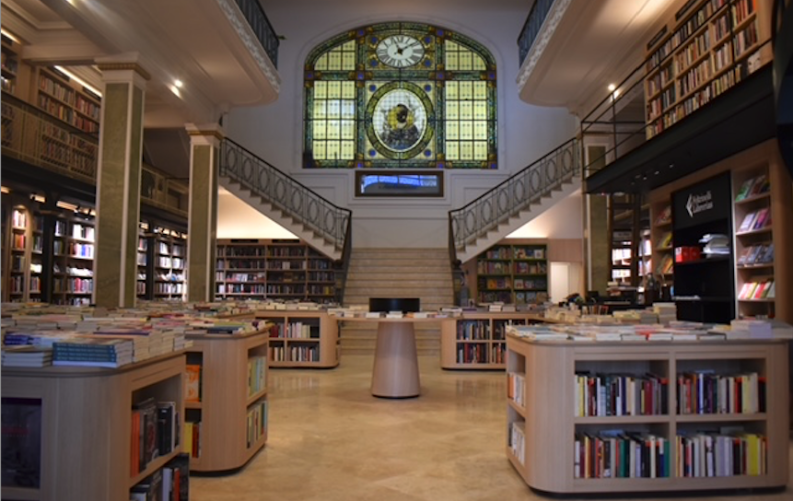

The new Feltrinelli bookshop in Montevideo
By Olivia Snaije, Contributing Editor
This weekend, on February 28, Feltrinelli, the major independent and family-owned Italian publishing and bookselling group, will open its first book shop in Latin America, in Montevideo, Uruguay. Feltrinelli president Carlo Feltrinelli and CEO Alessandra Carra will be at the opening of the 650 square-meter bookshop in the art nouveau Pablo Ferrando building, along with a variety of Latin American publishers.For Feltrinelli, the store represents an important milestone and embodies the company’s ambition to expand beyond Italian borders to the Spanish-speaking world—a desire first sparked more than 15 years ago.
Feltrinelli has long looked to Spain and Latin America, and “not only for commercial reasons,” Carra told Publishing Perspectives, but also out of “a natural cultural affinity.”
The fourth largest Italian group, Feltrinelli, founded in Milan in 1954 by Giangiacomo Feltrinelli, has historically stood for progressive values and the promotion of culture. And over the last few decades, Feltrinelli has built relationships with many Latin American authors, publishing some of the region’s greatest, from Jorge Luis Borges and Gabriel García Márquez, to Mariana Enriquez today.
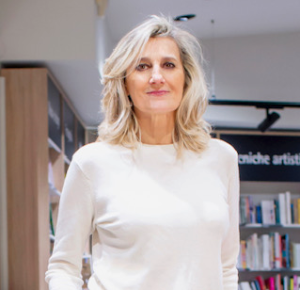
Feltrinelli CEO Alessandra Carra.
The company’s first expansion came in 2010, in Spain, with the progressive buyout of prestigious Barcelona-based independent publisher Anagrama. Founded by Jorge Herralde in 1969, Anagrama shares many of the leftist values held by Feltrinelli and is well-known for its publication of numerous Latin American authors. In 2017, following the completion of Feltrinelli’s phased buyout, Herralde turned his leadership over to Anagrama’s current director, Silvia Sesé.
But in 2007, prior to the acquisition of Anagrama, Inge Feltrinelli, Giangiacomo’s widow and Carlo’s mother, who ran Feltrinelli with her son until her death in 2018, had met Antonio Ramírez, co-founder with Marta Ramoneda of the Barcelona and Madrid bookshops La Central.
At the time, La Central was already on the radar of many literary Italians: Umberto Eco had once written an article in La Stampa on what he considered to be an ideal bookshop. In response, Roberto Calasso, the writer and former publisher of Adelphi Edizioni, responded to Eco by noting that the ideal bookshop already existed: it was La Central, in Barcelona.
Indeed, La Central had distinguished itself by its international character—some 40% of its books were in English, French, and Italian, which was in sync with Barcelona’s increasing cosmopolitanism. Furthermore, the Colombian-born Ramírez also paid particular attention to smaller independent publishing houses in Latin America.
By 2011, Ramírez and Ramoneda had opened three bookshops in Barcelona and one in Madrid, at the Reina Sofía museum. But they wanted to open a second bookshop in Madrid—and needed an investor. Feltrinelli seemed like the perfect partner, and the company soon came aboard as a minority shareholder. A second Madrid bookshop opened a year later, in 2012.
Ramírez said the idea was to open five more bookshops with Feltrinelli, one of which would be in Mexico City, where Ramírez had previously worked as a bookseller. Thus, Carlo Feltrinelli and Ramírez travelled to Latin America to scout potential locations.
“Carlo had always dreamed of opening a bookshop in Havana,” Ramírez said, an homage to his Marxist-Leninist father who had known Castro. Unfortunately, both Spain and Italy were in severe financial distress during those years, and their plans had to be put on hold.
But by 2020, Feltrinelli, which had slowly been increasing its stake in La Central, became the majority shareholder. And last year, Feltrinelli opened a new La Central bookshop in Barcelona, just off the city’s elegant Passeig de Gràcia.
Brand Names
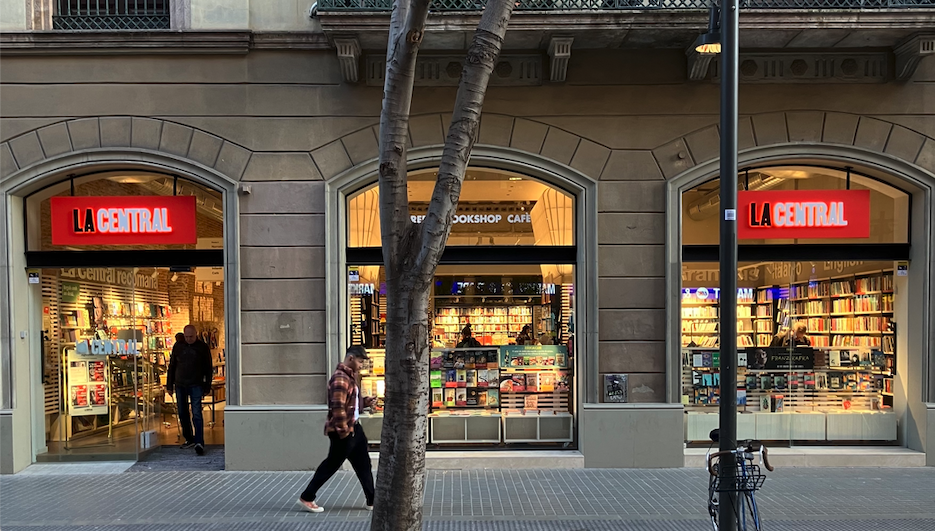
The recently opened La Central in Barcelona (credit: Olivia Snaije).
For years, there has been at least some speculation about where Feltrinelli’s acquisition of Anagrama could lead.
“Anagrama is a leading brand in both the Spanish and Latin American markets, which is where the most promising opportunities lie in the medium term. Is the idea of a chain of bookstores across Latin America and Spain under the Anagrama-Feltrinelli banner far-fetched? Not at all,” observed Manuel Gil, who would later serve as the director of the Madrid book fair from 2017-2021, in a 2011 blog post. “While the Spanish publisher is a symbol of consistency and quality throughout the Spanish-speaking world, Feltrinelli remains virtually unknown there—and this is precisely where the synergies could become the cornerstone of the partnership.”
Gil went on to add that “a high-quality bookstore chain” would be “indispensable” in both Latin America and Spain. And a bookstore chain that “meticulously champions independent publishing” would be not only be “desirable,” but “absolutely essential.”
Gil was slightly ahead of his time. When he wrote that post in 2011, Feltrinelli had not yet bought out La Central bookshops. But with the acquisition now complete, some may be left to wonder why Feltrinelli isn’t using Anagrama or La Central to brand its expansion into Latin America, given that La Central was co-founded by a Latin American. Being Barcelona-based would also protect La Central from being seen as a colonizer, which might have happened with a Madrid bookshop.
In response to questions about why Feltrinelli decided to cross the Atlantic with its own brand, rather than using Anagrama or La Central, Carra explained that La Central is a bookstore project “deeply rooted” in the territories of Madrid and Barcelona. And, both Feltrinelli and Anagrama each have their own “strong and distinctive identities built over time,” Carra said, brands that could be enhanced without having to combine them.
Anagrama is currently experiencing a solid phase of growth, Carra points out, noting that revenues exceeded €29 million ($34 million) in 2025—up 8.75% year over year and up 49% over the past five years, with “particularly significant results” in Argentina and Mexico.
“The decision to expand into Latin America under the Feltrinelli brand stems from the desire to bring our editorial and cultural identity directly into new contexts,” Carra says, “maintaining a strong connection with Feltrinelli’s Italian bookstore experience, while shaping a cultural focus that centers on Latin American publishers and offers a selection of Italian literature that we believe can represent an exciting and meaningful novelty for readers.”
Fertile Ground
In 2024, Feltrinelli established a holding company in Spain that groups together Anagrama, La Central, and the new Fundación Feltrinelli Anagrama, a foundation dedicated to ideas, culture, and public debate.
Ramírez, who stepped down from La Central last year will be involved in educational projects within the foundation, such as training for booksellers and publishers mostly coming from Latin America. The foundation also houses Anagrama’s archives, and this spring will begin its program of talks with the Albanian-born political philosopher Lea Ypi who will explorie inequality and citizenship in a talk at the inaugural event in Barcelona.
Anagrama’s Sesé, meanwhile, confirmed to Publishing Perspectives that Feltrinelli will also launch a publishing imprint in Spanish in Barcelona, in May 2026. Few details are available at this time, but it is likely the imprint will be overseen by Sesé.
As far as Feltrinelli’s next steps in Latin America, Carra says the ground is particularly fertile for the Italian company’s expansion there, while stressing a “measured, phased” approach.
“The goal is to bring and further strengthen Feltrinelli’s editorial and cultural identity in the region, reinforcing an exchange that has existed for decades and that, today, can find new forms and opportunities,” Carra says, citing Latin America’s “dynamic cultural environment” and, a readership with a great appetite for books.
“While we are exploring several opportunities, we believe in moving one step at a time,” she says. “We are starting in Montevideo to establish a solid foundation before evaluating where to take the Feltrinelli experience next.”